
The Royal Fusiliers (City of London) Regiment was formed on the 1st July 1881 from the 7th (Derbyshire) Regiment of Foot. (The Derbyshire title, granted in 1782, was never used and in 1823 had been re-granted to the 95th Regiment).
There are over 55,000 Royal Fusiliers service and pension records (for this regiment - and its antecedents) in various War
Office series held at the National Archives. Clicking on the link will take you
to the results on Findmypast but
you will need a subscription or Pay-Per-View credits to actually view the
records. Some of these records can also be viewed on-line on Ancestry although Findmypast has by far the most comprehensive
service record collection.
The newly
formed regiment was established as the city regiment for London
14 joined on 3rd October
1881
335 joined on 9th June 1882
976 joined on 11th June 1883
1191 joined on 31st January 1884
1827 joined on 15th May 1885
2363 joined on 30th January 1886
2798 joined on 18th March 1887
3078 joined on 17th April 1888
3224 joined on 25th June 1889
3465 joined on 25th January 1890
3701 joined on 7th January 1891
4049 joined on 9th January 1892
4579 joined on 2nd February 1893
4964 joined on 3rd April 1894
5283 joined on 19th April 1895
5479 joined on 13th June 1896
5800 joined on 20th October 1897
5929 joined on 15th March 1898
335 joined on 9th June 1882
976 joined on 11th June 1883
1191 joined on 31st January 1884
1827 joined on 15th May 1885
2363 joined on 30th January 1886
2798 joined on 18th March 1887
3078 joined on 17th April 1888
3224 joined on 25th June 1889
3465 joined on 25th January 1890
3701 joined on 7th January 1891
4049 joined on 9th January 1892
4579 joined on 2nd February 1893
4964 joined on 3rd April 1894
5283 joined on 19th April 1895
5479 joined on 13th June 1896
5800 joined on 20th October 1897
5929 joined on 15th March 1898
On the 1st April 1898 a 3rd
regular battalion was raised at The Curragh, Ireland
7173 joined on 22nd February 1899 [L/ prefix added later]
On the 30th January 1900,
The Royal Fusiliers raised a 4th Battalion from the nucleus of the 3rd
Battalion. This battalion also shared
the same number series that was in use for the other three regular
battalions. The 4th Battalion would
eventually be disbanded on the 16th July 1922.
The Royal Fusiliers also
fielded two volunteer service companies during the South African War. Numbers issued to VSC recruits were within
the range 8901 to 9144. Numbers 8901 through to 9026 were all 1st VSC men. Numbers 9040 through to 9144 were all 2nd VSC
men. Numbers 9027 to 9039 are a
combination of 1st and 2nd VSC men.
7825 joined on 5th February
1900 [L/ prefix added later]
8635 joined on 10th January
1901
RF/9364 joined on 24th January 1902 [L/ prefix added later]
RF/9364 joined on 24th January 1902 [L/ prefix added later]
In
1901 alone, and with four regular battalions in place, The Royal Fusiliers
recruited well over 700 men and recruitment showed no signs of slowing in
1902. Queen’s Regulations stated that,
“When the [number] series approaches 9,999, application should be made to the
Adjutant-General in sufficient time to obtain authority to commence a new
series.” This instruction was either
overlooked or ignored by the Royal Fusiliers, or the application was submitted
too late. Although a revised King’s
Regulations would extend numbering in infantry regiments to 19,999, this
wouldn’t come into effect until 1904, and by November 1902, the Royal Fusiliers
had passed 9,999 and just kept going.
The regiment would recruit over 800 men in 1902 alone.
The
L/ prefix was introduced for regular enlistments into regiments administered by
the Number 10 Grouped Regimental District at Hounslow around October 1902. This practice was also adopted by The Royal
Fusiliers at the same time. An RF/
prefix was already in use for the Royal Fusiliers and certainly appears to have
been more consistently used than the L/ prefix when this was introduced for
regulars joining the regiment. The numbers above and below are as they appear
on attestation papers. In all cases the
L/ prefix appears to have been added some time after the man had attested.
RF/10145 joined on 1st January 1903 [L/ prefix added later]
RF/10830 joined on 23rd January 1904
RF/11128 joined on 16th January 1905
RF/11891 joined on 1st January 1906
RF/12477 joined on 4th February 1907 [L/ prefix added later]
RF/13039 joined on 15th January 1908
RF/13742 joined on 6th July 1909
RF/14193 joined on 20th October 1910
RF/14344 joined on 4th January 1911 [L/ prefix added later]
RF/15158 joined on 12th June 1912
RF/15459 joined on 11th January 1913
RF/16125 joined on 27th July 1914 [L/ prefix added later]
The First World War
When Britain
This
practice was adopted by The Queen’s (Royal West Surrey Regiment), The Buffs
(East Kent Regiment), The Royal Fusiliers, The East Surrey Regiment, The Royal
Sussex Regiment, The Royal West Kent Regiment and The Middlesex Regiment. With
the exception of the Royal Fusiliers, these regiments were all administered by
the Number 10 Grouped Regimental District at Hounslow. The Royal Fusiliers also
raised a number of Pals-type battalions, most of which operated separate number
series, many of these being additionally differentiated by letter
prefixes.
Recruitment
rates 1881-1911
Between
1st July 1881 and 17th January 1891, The Royal Fusiliers recruited 3,701 men,
an average of 386 soldiers a year and the fourteenth best recruitment rate of
all the British infantry regiments that decade.
The
following decade showed further improvement with a grand total of 8635 men
recruited by 10th January 1901 and an average recruitment rate for the decade
which stood at 493 men per annum.
Recruitment
into the Royal Fusiliers showed no sign of abating during the period 1901 to
1911 and by 4th January that year, the regiment had issued number RF/14344 to
its latest recruit. By 1911 The Royal
Fusiliers was the fifth most successful recruiter of all the British infantry
regiments and could claim a high annual average of 483 men recruited per annum
between 1881 and 1911.
The well-known photo that I've used to illustrate this post shows men of A Company, 4th Battalion, Royal Fusiliers at rest on the 22nd August 1914. The following day they would be in action at the Battle of Mons. Photo source: Wikipedia.
I also offer a comprehensive, fast and cost-effective military history research service. Follow the link for more information.
Further Reading
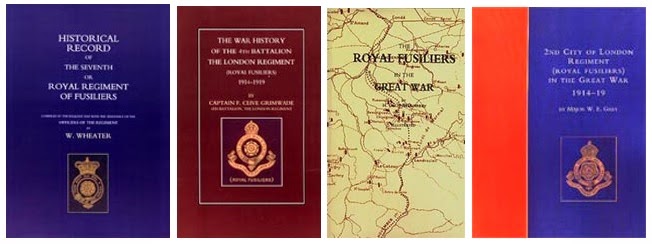
Historical Records of the Seventh or Royal Regiment of Fusiliers
Covers the period form the raising of the regiment in 1685 to 1875. Includes a roll call of every officer who served in the Regiment during these 190 years with his record of service, listed in alphabetical order.
Royal Fusiliers in the Great War
The appendix gives the Roll of Honour of officers (1054 names); a table showing the numbers of Warrant Officers, NCOs and Men on the Roll of Honour, by battalions; a table summarising decorations awarded, including foreign awards; brief biographies or notes on a number of RF general ranking officers; and several accounts of soldiers who took part in the various operations.2nd City of London Regiment (Royal Fusiliers) in the Great War 1914-1919
The Roll of Honour lists 1,345 dead and the summary of awards shows 65 British decorations to officers and 246 to other ranks, excluding MiDs.The War History of the 4th Battalion The London Regiment (Royal Fusiliers) 1914-1919
Includes a list of Honours and Awards, including foreign decorations, as well as a list of officers and men of other regiments who won their awards serving with the 4th London Regiment.The History of the old 2/4th (City of London) Battalion, The London Regiment (Royal Fusiliers)
There is no Roll of Honour nor list of Honours and Awards, all these are noted in the text and the last ninety pages contain the service records of every officer and man of the battalion where such information can be found, including details of any wounds received.The Kensington Battalion
This books draws on first hand material (diaries, letters and official documents) as well as interviews from the 1980s. History of the 22nd (Service) Battalion, Royal Fusiliers (Kensington)
A Roll of Honour gives dates of death of the officers, and in the case of other ranks, they are grouped by companies for each year of the war without number, rank or date of death. There is also a list of recipients of honours and awards, which includes mentioned in despatches. Names are grouped alphabetically for each medal, but no number, rank or date of award. Hard as Nails: The Sportsmen's Battalion of World War One
Michael Foley's history of the 23rd (Service) Battalion.
I also offer a comprehensive, fast and cost-effective military history research service. Follow the link for more information.
Further Reading
Historical Records of the Seventh or Royal Regiment of Fusiliers
Covers the period form the raising of the regiment in 1685 to 1875. Includes a roll call of every officer who served in the Regiment during these 190 years with his record of service, listed in alphabetical order.
Royal Fusiliers in the Great War
The appendix gives the Roll of Honour of officers (1054 names); a table showing the numbers of Warrant Officers, NCOs and Men on the Roll of Honour, by battalions; a table summarising decorations awarded, including foreign awards; brief biographies or notes on a number of RF general ranking officers; and several accounts of soldiers who took part in the various operations.2nd City of London Regiment (Royal Fusiliers) in the Great War 1914-1919
The Roll of Honour lists 1,345 dead and the summary of awards shows 65 British decorations to officers and 246 to other ranks, excluding MiDs.The War History of the 4th Battalion The London Regiment (Royal Fusiliers) 1914-1919
Includes a list of Honours and Awards, including foreign decorations, as well as a list of officers and men of other regiments who won their awards serving with the 4th London Regiment.The History of the old 2/4th (City of London) Battalion, The London Regiment (Royal Fusiliers)
There is no Roll of Honour nor list of Honours and Awards, all these are noted in the text and the last ninety pages contain the service records of every officer and man of the battalion where such information can be found, including details of any wounds received.The Kensington Battalion
This books draws on first hand material (diaries, letters and official documents) as well as interviews from the 1980s. History of the 22nd (Service) Battalion, Royal Fusiliers (Kensington)
A Roll of Honour gives dates of death of the officers, and in the case of other ranks, they are grouped by companies for each year of the war without number, rank or date of death. There is also a list of recipients of honours and awards, which includes mentioned in despatches. Names are grouped alphabetically for each medal, but no number, rank or date of award. Hard as Nails: The Sportsmen's Battalion of World War One
Michael Foley's history of the 23rd (Service) Battalion.


