The 22nd (Service) Battalion, The Royal Fusiliers (Kensington) was raised by the Mayor and Borough of Kensington on 11th September 1914 at the White City. It moved to Roffey Camp, Horsham, Sussex in October 1914 and by June 1915 it was at Clipstone Camp, as part of the 99th Brigade (along with 17th, 23rd and 24th Battalions RF) in the 33rd Division. It landed at Boulogne in November 1915.
Bert Danson of the Ten Tommies joined this battalion and, like all new recruits to the battalion - certainly the initial intake at least - his number was prefixed with the letter K/ for Kensington. Numbering started at 1 and by by June 1915 it had reached the 1500s. This post will look at numbering in the Kensington Battalion between August 1914 and June 1915.
With the exception of the first number, below, service records for the following numbers survive in the WO 363 (Burnt Documents) and WO 364 (Pensions) series at the National Archives in Kew, London. These records can also be viewed on-line via Ancestry.co.uk which is currently offering a FREE 14 day trial.
K/225 joined on 25th August 1914
K/464 joined on 18th September 1914
K/1223 joined on 14th November 1914
K/1244 joined on 5th December 1915
K/1369 joined on 13th February 1915
K/1452 joined on 24th April 1915
K/1521 joined on 31st May 1915
K/1574 joined on 7th June 1915
The author, Saki (Hector Hugh Munro, pictured) was the K/225 mentioned above. He would be killed in action with the Kensington Battalion in November 1916.
I also offer a comprehensive, fast and cost-effective military history research service. Follow the link for more information.
From The Naval & Military Press:
The 22nd (Service) Battalion, The Royal Fusiliers (Kensington) was raised by the Mayor and Borough of Kensington on 11th September 1914 at the White City. It moved to Roffey Camp, Horsham, Sussex in October 1914 and by June 1915 it was at Clipstone Camp, as part of the 99th Brigade (along with 17th, 23rd and 24th Battalions RF) in the 33rd Division. It landed at Boulogne in November 1915.
Bert Danson of the Ten Tommies joined this battalion and, like all new recruits to the battalion - certainly the initial intake at least - his number was prefixed with the letter K/ for Kensington. Numbering started at 1 and by by June 1915 it had reached the 1500s. This post will look at numbering in the Kensington Battalion between August 1914 and June 1915.
With the exception of the first number, below, service records for the following numbers survive in the WO 363 (Burnt Documents) and WO 364 (Pensions) series at the National Archives in Kew, London. These records can also be viewed on-line via Ancestry.co.uk which is currently offering a FREE 14 day trial.
K/225 joined on 25th August 1914
K/464 joined on 18th September 1914
K/1223 joined on 14th November 1914
K/1244 joined on 5th December 1915
K/1369 joined on 13th February 1915
K/1452 joined on 24th April 1915
K/1521 joined on 31st May 1915
K/1574 joined on 7th June 1915
The author, Saki (Hector Hugh Munro, pictured) was the K/225 mentioned above. He would be killed in action with the Kensington Battalion in November 1916.
I also offer a comprehensive, fast and cost-effective military history research service. Follow the link for more information.
From The Naval & Military Press:
 A History of the 22nd (Service) Battalion, Royal Fusiliers (Kensington)
This book, as the editor stresses, was compiled for the surviving members of the battalion. Some 410 died and Lance-Sergeant Palmer (who also held the Military Medal) won the Victoria Cross near Courcelette in February 1917.
There is a Roll of Honour in which the dates of death of the officers are given, but in the case of other ranks, they are helpfully grouped by companies for each year of the war but unhelpfully without number, rank or date of death. Researchers would need to piece this latter information together by referring to Soldiers Died in The Great War.
There is also a list of recipients of honours and awards, headed by L/Sgt Palmer with his VC. In this list, which includes mentioned in despatches, names are grouped alphabetically for each medal but again, no number, rank or date of award. CLICK HERE TO ORDER.
Also see these other Royal Fusiliers titles
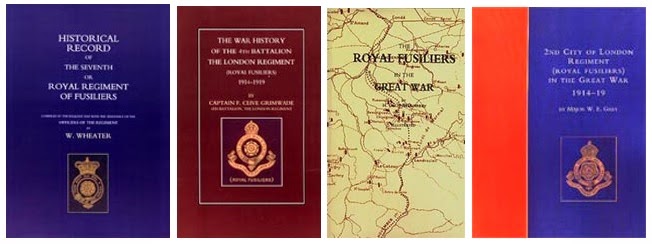
Historical Records of the Seventh or Royal Regiment of Fusiliers
Covers the period form the raising of the regiment in 1685 to 1875. Includes a roll call of every officer who served in the Regiment during these 190 years with his record of service, listed in alphabetical order.
Royal Fusiliers in the Great War
The appendix gives the Roll of Honour of officers (1054 names); a table showing the numbers of Warrant Officers, NCOs and Men on the Roll of Honour, by battalions; a table summarising decorations awarded, including foreign awards; brief biographies or notes on a number of RF general ranking officers; and several accounts of soldiers who took part in the various operations.
2nd City of London Regiment (Royal Fusiliers) in the Great War 1914-1919
The Roll of Honour lists 1,345 dead and the summary of awards shows 65 British decorations to officers and 246 to other ranks, excluding MiD.
The War History of the 4th Battalion The London Regiment (Royal Fusiliers) 1914-1919
Includes a list of Honours and Awards, including foreign decorations, as well as a list of officers and men of other regiments who won their awards serving with the 4th London Regiment.
The History of the old 2/4th (City of London) Battalion, The London Regiment (Royal Fusiliers)There is no Roll of Honour nor list of Honours and Awards, all these are noted in the text and the last ninety pages contain the service records of every officer and man of the battalion where such information can be found, including details of any wounds received.
The Kensington Battalion
This books draws on first hand material (diaries, letters and official documents) as well as interviews from the 1980s.
Hard as Nails: The Sportsmen's Battalion of World War One
Michael Foley's history of the 23rd (Service) Battalion.
A History of the 22nd (Service) Battalion, Royal Fusiliers (Kensington)
This book, as the editor stresses, was compiled for the surviving members of the battalion. Some 410 died and Lance-Sergeant Palmer (who also held the Military Medal) won the Victoria Cross near Courcelette in February 1917.
There is a Roll of Honour in which the dates of death of the officers are given, but in the case of other ranks, they are helpfully grouped by companies for each year of the war but unhelpfully without number, rank or date of death. Researchers would need to piece this latter information together by referring to Soldiers Died in The Great War.
There is also a list of recipients of honours and awards, headed by L/Sgt Palmer with his VC. In this list, which includes mentioned in despatches, names are grouped alphabetically for each medal but again, no number, rank or date of award. CLICK HERE TO ORDER.
Also see these other Royal Fusiliers titles
Historical Records of the Seventh or Royal Regiment of Fusiliers
Covers the period form the raising of the regiment in 1685 to 1875. Includes a roll call of every officer who served in the Regiment during these 190 years with his record of service, listed in alphabetical order.
Royal Fusiliers in the Great War
The appendix gives the Roll of Honour of officers (1054 names); a table showing the numbers of Warrant Officers, NCOs and Men on the Roll of Honour, by battalions; a table summarising decorations awarded, including foreign awards; brief biographies or notes on a number of RF general ranking officers; and several accounts of soldiers who took part in the various operations.
2nd City of London Regiment (Royal Fusiliers) in the Great War 1914-1919
The Roll of Honour lists 1,345 dead and the summary of awards shows 65 British decorations to officers and 246 to other ranks, excluding MiD.
The War History of the 4th Battalion The London Regiment (Royal Fusiliers) 1914-1919
Includes a list of Honours and Awards, including foreign decorations, as well as a list of officers and men of other regiments who won their awards serving with the 4th London Regiment.
The History of the old 2/4th (City of London) Battalion, The London Regiment (Royal Fusiliers)There is no Roll of Honour nor list of Honours and Awards, all these are noted in the text and the last ninety pages contain the service records of every officer and man of the battalion where such information can be found, including details of any wounds received.
The Kensington Battalion
This books draws on first hand material (diaries, letters and official documents) as well as interviews from the 1980s.
Hard as Nails: The Sportsmen's Battalion of World War One
Michael Foley's history of the 23rd (Service) Battalion.
This battalion had its origins in the 4th Middlesex Volunteer Rifles Corps. Its headquarters was at Iverna Gardens, Kensington.
201 joined on 4th April 1908
570 joined on 19th February 1909
1044 joined on 8th February 1910
1147 joined on 10th January 1911
1293 joined on 14th May 1912
1367 joined on 21st January 1913
1540 joined on 3rd March 1914
1725 joined on 5th August 1914
2430 joined on 1st September 1914
3311 joined on 10th November 1914
3672 joined on 10th December 1914
3846 joined on 20th January 1915
3944 joined on 9th February 1915
4025 joined on 8th March 1915
4091 joined on 12th April 1915
4249 joined on 12th May 1915
4313 joined on 8th June 1915
4421 joined on 14th July 1915
4461 joined on 9th August 1915
4489 joined on 9th September 1915
4518 joined on 5th October 1915
4550 joined on 8th November 1915
4651 joined on 11th December 1915
4690 joined on 12th February 1916
4753 joined on 31st March 1916
4814 joined on 1st April 1916
5282 joined on 2nd May 1916
5403 joined on 5th June 1916
5717 joined on 4th July 1916
6384 joined on 21st August 1916
6483 joined on 1st September 1916
6629 joined on 17th October 1916
6784 joined on 20th November 1916
When the Territorial Force was re-numbered in 1917, The 13th Londons re-numbered within the block 490001 to 510000. Here are some sample army service numbers and corresponding joining dates within the six digit range:
490025 originally joined on 19th February 1909
490057 originally joined on 9th January 1912
490149 originally joined on 16th September 1913
490252 originally joined on 5th August 1914
490510 originally joined on 1st September 1914
490928 originally joined on 12th November 1914
491130 originally joined on 17th December 1914
491216 originally joined on 13th January 1915
491307 originally joined on 5th February 1915
491367 originally joined on 5th March 1915
491585 originally joined on 28th June 1915
491720 originally joined on 8th November 1915
493278 originally joined on 30th August 1916
493924 joined on 16th January 1917
494058 joined on 14th February 1917
494264 joined on 30th March 1917
494291 joined on 23rd April 1917
495322 joined on 9th May 1917
495671 joined on 11th June 1917
495897 joined on 11th October 1917
496075 joined on 9th January 1918
496634 joined on 21st May 1918
BEWARE!
It is wrong to assume that numbers were issued in a strict sequential sequence. They weren't. As the war progressed and casualties grew, large numbers of men were often transferred from one battalion to another and allocated numbers within blocks which did not fit the sequential patterning seen to date. This becomes particularly evident in most battalions from 1916 onwards.
As an example, take a look at these six digit numbers for the Kensingtons beginning 505***.
c505004 to 505027
Numbers in this range were issued to men who transferred in France, from the 23rd Londons to the 13th Londons. This transfer took place on 14th April 1917 and NOT in 1918 as could be implied from the sequential list above.
c505038 to 505045
Issued to men who had transferred from the 8th Londons to the 13th Londons.
c505049 to 505063
Issued to men who had transferred from the 17th Londons to the 13th Londons.
c505073 to 505096
Issued to men who had transferred from the 18th Londons to the 13th Londons
It gets messier from here, men with numbers in the 5051** and 5052** range being transferred from a variety of regiments, the majority of which are other London Regiment battalions but also men from the Sussex Yeomanry, Monmouthshire Regiment and others. I suspect that men in the 505*** range were all transferred in April 1917, but I'll check this.
Find your army ancestors today with a FREE 14 day trial to Ancestry.co.uk - Click here!
Read the history of The Kensingtons (first published in 1936) this from the N&MP blurb on their advertised reprint below:
"A brief account of the history of the Kensingtons before the Great War is given in the opening chapter of this book. When war broke out the battalion was already allocated to the 4th London Brigade, 2nd London Division, but in November 1914 it left the division and went to France, arriving on 4th; it was allocated to 25th Brigade, 8th Division, a newly formed regular division, with which it fought its first major action, at Neuve Chapelle in March 1915. After a spell on the Lines of Communication the battalion joined the re-formed 1st London Division (now numbered 56th) in 168th Brigade, and it fought in that brigade on the Western Front for the rest of the war.
"In September 1914 a second line battalion was formed (2/13th) which was assigned to179th Brigade 60th Division. An unexpected diversion occurred at the end of April 1916 when the brigade was sent to Ireland on internal security duties following the Easter rebellion. A fortnight later it returned to England and on 21 June the 60th Division began its move to France. After about four months in the Vimy sector the division was transferred to Macedonia where the battalion arrived at the end of November 1916. Its spell in that theatre was comparatively short for in May 1917 the division moved again - to Palestine where it served with the Egyptian Expeditionary Force until the end of the war.
"This history is arranged in two parts, the first deals with the first line battalion, 1/4th, and is written by Sgt Bailey; the second part is the history of the 2/4th, written by Sgt Hollier. There is a final chapter covering the post-war period up to 1935, written by one of the commanding officers. The Roll of Honour lists the dead (60 officers 1003 men), alphabetically by ranks, without identifying battalion, nor does the list of Honours and Awards identify the battalion."
I also offer a comprehensive, fast and cost-effective military history research service. Follow the link for more information.
Read my other posts on numbering in the London Regiment battalions:
City of London Battalions
1st (City of London) Battalion (Royal Fusiliers)
2nd (City of London) Battalion (Royal Fusiliers)
3rd (City of London) Battalion (Royal Fusiliers)
4th (City of London) Battalion (Royal Fusiliers)
5th (City of London) Battalion (Rifle Brigade)
6th (City of London) Battalion (Rifles)
7th (City of London) Battalion
8th (City of London) Battalion (Post Office Rifles)
County of London Battalions
9th (County of London) Battalion (Queen Victoria's Rifles)
10th County of London) Battalion (Hackney) [Originally Paddington Rifles]
11th (County of London) Battalion (Finsbury Rifles)
12th (County of London) Battalion (The Rangers)
14th (County of London) Battalion (London Scottish)
15th (County of London) Battalion (Prince of Wales's Own Civil Service Rifles)
16th (County of London) Battalion (Queen's Westminster Rifles)
17th (County of London) Battalion (Poplar & Stepney Rifles)
18th (County of London) Battalion (London Irish Rifles)
19th (County of London) Battalion (St Pancras)
20th (County of London) Battalion (Blackheath & Woolwich)
21st (County of London) Battalion (First Surrey Rifles)
22nd (County of London) Battalion (The Queen's)
23rd (County of London) Battalion
24th (County of London) Battalion (The Queen's)
25th (County of London) Cyclist Battalion
28th (County of London) Battalion (Artists Rifles)