21 December 2012

Royal Fusiliers - Regular Battalions


The Royal Fusiliers (City of London) Regiment was formed on the 1st July 1881 from the 7th (Derbyshire) Regiment of Foot.  (The Derbyshire title, granted in 1782, was never used and in 1823 had been re-granted to the 95th Regiment). 


There are over 55,000 Royal Fusiliers service and pension records (for this regiment - and its antecedents) in various War Office series held at the National Archives. Clicking on the link will take you to the results on Findmypast but you will need a subscription or Pay-Per-View credits to actually view the records. Some of these records can also be viewed on-line on Ancestry although Findmypast has by far the most comprehensive service record collection.

The newly formed regiment was established as the city regiment for London and started numbering from 1 in 1881. 

14 joined on 3rd October 1881
335 joined on 9th June 1882
976 joined on 11th June 1883
1191 joined on 31st January 1884
1827 joined on 15th May 1885
2363 joined on 30th January 1886
2798 joined on 18th March 1887
3078 joined on 17th April 1888
3224 joined on 25th June 1889
3465 joined on 25th January 1890
3701 joined on 7th January 1891
4049 joined on 9th January 1892
4579 joined on 2nd February 1893
4964 joined on 3rd April 1894
5283 joined on 19th April 1895
5479 joined on 13th June 1896
5800 joined on 20th October 1897
5929 joined on 15th March 1898
 

On the 1st April 1898 a 3rd regular battalion was raised at The Curragh, Ireland, from the nucleus of two companies from the 2nd Battalion.  Recruits joining the 3rd Battalion were issued with numbers from the same series that was being used by 1st and 2nd Battalion men.  The 3rd Battalion would eventually be disbanded on 16th July 1922.

7173 joined on 22nd February 1899 [L/ prefix added later]
 

On the 30th January 1900, The Royal Fusiliers raised a 4th Battalion from the nucleus of the 3rd Battalion.  This battalion also shared the same number series that was in use for the other three regular battalions.  The 4th Battalion would eventually be disbanded on the 16th July 1922.

The Royal Fusiliers also fielded two volunteer service companies during the South African War.  Numbers issued to VSC recruits were within the range 8901 to 9144. Numbers 8901 through to 9026 were all 1st VSC men.  Numbers 9040 through to 9144 were all 2nd VSC men.  Numbers 9027 to 9039 are a combination of 1st and 2nd VSC men. 

7825 joined on 5th February 1900 [L/ prefix added later]
8635 joined on 10th January 1901
RF/9364 joined on 24th January 1902 [L/ prefix added later]
 

In 1901 alone, and with four regular battalions in place, The Royal Fusiliers recruited well over 700 men and recruitment showed no signs of slowing in 1902.  Queen’s Regulations stated that, “When the [number] series approaches 9,999, application should be made to the Adjutant-General in sufficient time to obtain authority to commence a new series.”  This instruction was either overlooked or ignored by the Royal Fusiliers, or the application was submitted too late.  Although a revised King’s Regulations would extend numbering in infantry regiments to 19,999, this wouldn’t come into effect until 1904, and by November 1902, the Royal Fusiliers had passed 9,999 and just kept going.  The regiment would recruit over 800 men in 1902 alone.  

The L/ prefix was introduced for regular enlistments into regiments administered by the Number 10 Grouped Regimental District at Hounslow around October 1902.  This practice was also adopted by The Royal Fusiliers at the same time.  An RF/ prefix was already in use for the Royal Fusiliers and certainly appears to have been more consistently used than the L/ prefix when this was introduced for regulars joining the regiment. The numbers above and below are as they appear on attestation papers.  In all cases the L/ prefix appears to have been added some time after the man had attested.

RF/10145 joined on 1st January 1903 [L/ prefix added later]
RF/10830 joined on 23rd January 1904
RF/11128 joined on 16th January 1905
RF/11891 joined on 1st January 1906
RF/12477 joined on 4th February 1907 [L/ prefix added later]
RF/13039 joined on 15th January 1908
RF/13742 joined on 6th July 1909
RF/14193 joined on 20th October 1910
RF/14344 joined on 4th January 1911 [L/ prefix added later]
RF/15158 joined on 12th June 1912
RF/15459 joined on 11th January 1913
RF/16125 joined on 27th July 1914 [L/ prefix added later]

The First World War


When Britain went to war in August 1914, men joining the new Royal Fusiliers service battalions for wartime-service only were issued with numbers from new number series. The number series outlined above, continued to be used but was reserved for those men who wished to join the Royal Fusiliers on regular enlistment terms. 

This practice was adopted by The Queen’s (Royal West Surrey Regiment), The Buffs (East Kent Regiment), The Royal Fusiliers, The East Surrey Regiment, The Royal Sussex Regiment, The Royal West Kent Regiment and The Middlesex Regiment. With the exception of the Royal Fusiliers, these regiments were all administered by the Number 10 Grouped Regimental District at Hounslow. The Royal Fusiliers also raised a number of Pals-type battalions, most of which operated separate number series, many of these being additionally differentiated by letter prefixes.   

Recruitment rates 1881-1911

Between 1st July 1881 and 17th January 1891, The Royal Fusiliers recruited 3,701 men, an average of 386 soldiers a year and the fourteenth best recruitment rate of all the British infantry regiments that decade. 

The following decade showed further improvement with a grand total of 8635 men recruited by 10th January 1901 and an average recruitment rate for the decade which stood at 493 men per annum. 

Recruitment into the Royal Fusiliers showed no sign of abating during the period 1901 to 1911 and by 4th January that year, the regiment had issued number RF/14344 to its latest recruit.  By 1911 The Royal Fusiliers was the fifth most successful recruiter of all the British infantry regiments and could claim a high annual average of 483 men recruited per annum between 1881 and 1911.
The well-known photo that I've used to illustrate this post shows men of A Company, 4th Battalion, Royal Fusiliers at rest on the 22nd August 1914.  The following day they would be in action at the Battle of Mons. Photo source: Wikipedia.

I also offer a comprehensive, fast and cost-effective military history research service. Follow the link for more information.

Further Reading
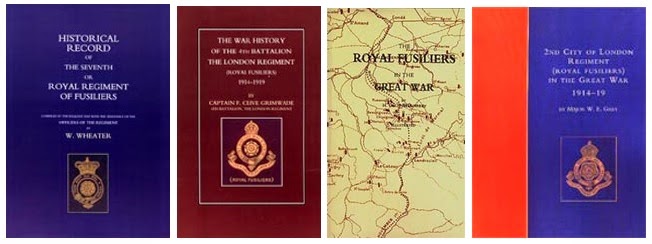
Royal Fusiliers - regimental histories

Historical Records of the Seventh or Royal Regiment of Fusiliers
Covers the period form the raising of the regiment in 1685 to 1875. Includes a roll call of every officer who served in the Regiment during these 190 years with his record of service, listed in alphabetical order.
Royal Fusiliers in the Great War
The appendix gives the Roll of Honour of officers (1054 names); a table showing the numbers of Warrant Officers, NCOs and Men on the Roll of Honour, by battalions; a table summarising decorations awarded, including foreign awards; brief biographies or notes on a number of RF general ranking officers; and several accounts of soldiers who took part in the various operations.2nd City of London Regiment (Royal Fusiliers) in the Great War 1914-1919
The Roll of Honour lists 1,345 dead and the summary of awards shows 65 British decorations to officers and 246 to other ranks, excluding MiDs.The War History of the 4th Battalion The London Regiment (Royal Fusiliers) 1914-1919
Includes a list of Honours and Awards, including foreign decorations, as well as a list of officers and men of other regiments who won their awards serving with the 4th London Regiment.The History of the old 2/4th (City of London) Battalion, The London Regiment (Royal Fusiliers)
There is no Roll of Honour nor list of Honours and Awards, all these are noted in the text and the last ninety pages contain the service records of every officer and man of the battalion where such information can be found, including details of any wounds received.The Kensington Battalion
This books draws on first hand material (diaries, letters and official documents) as well as interviews from the 1980s. History of the 22nd (Service) Battalion, Royal Fusiliers (Kensington)
A Roll of Honour gives dates of death of the officers, and in the case of other ranks, they are grouped by companies for each year of the war without number, rank or date of death. There is also a list of recipients of honours and awards, which includes mentioned in despatches. Names are grouped alphabetically for each medal, but no number, rank or date of award. Hard as Nails: The Sportsmen's Battalion of World War One
Michael Foley's history of the 23rd (Service) Battalion.

Queen's Own Cameron Highlanders


The Queen’s Own Cameron Highlanders was formed on 1st July 1881 from the 79th (The Queen’s Own Cameron Highlanders) Regiment of Foot, and initially consisted of one battalion – the 1st Battalion.   

There are over 30,000 Queen's Own Cameron Highlanders service and pension records (for this regiment - and its antecedents) in various War Office series held at the National Archives. Clicking on the link will take you to the results on Findmypast but you will need a subscription or Pay-Per-View credits to actually view the records. Some of these records can also be viewed on-line on Ancestry although Findmypast has by far the most comprehensive service record collection.


Use the regimental numbers and dates on which these were issued, below, to determine parameters for when your own Cameron Highlanders ancestor would have joined up. Note though that these numbers are only for regular enlistments. Special Reserve and Territorial Force battalions operated completely separate regimental number sequences.

The newly formed regiment was established as the county regiment for Inverness-shire and started numbering from 1 in 1881.

10 joined on 28th July 1881
179 joined on 7th January 1882
805 joined on 28th February 1883
850 joined on 2nd February 1884
1221 joined on 9th January 1885
1865 joined on 12th January 1886
2018 joined on 17th February 1887
2103 joined on 15th February 1888
2184 joined on 11th January 1889
2309 joined on 2nd January 1890
2425 joined on 10th January 1891
2923 joined on 27th January 1892
3466 joined on 9th January 1893
3567 joined on 4th January 1894
3662 joined on 8th January 1895
3750 joined on 4th January 1896
 

On the 31st March 1897 the regiment raised a second regular battalion – the 2nd Battalion – at Fort George.  It drew its numbers from the same series as the 1st Battalion.

3857 joined on 22nd January 1897
4303 joined on 6th January 1898
4704 joined on 16th January 1899
5128 joined on 16th January 1900

Numbers 6248 to 6317 were issued in 1900 to men joining the 1st Volunteer Service Company, Queen’s Own Cameron Highlanders. The men embarked for South Africa aboard SS Gaul on the 14th April 1900.

5685 joined on 7th January 1901
6011 joined on 11th January 1902

6560 joined on 6th January 1903
6858 joined on 24th February 1904
7168 joined on 30th March 1905
7484 joined on 30th April 1906
7782 joined on 18th January 1907
8106 joined on 4th January 1908
8499 joined on 4th January 1909
8842 joined on 24th March 1910
9042 joined on 24th March 1911
9249 joined on 27th February 1912
9488 joined on 15th April 1913
9624 joined on 13th January 1914

The First World War

When Britain went to war in August 1914, men joining the new service battalions were at first issued with numbers from the same series that had, up until that point, been the sole preserve of the regiment’s two regular battalions.  The only difference between men enlisting for war-time service only and those enlisting as career soldiers, was that the numbers of the former were supposed to be prefixed with the letter S/.

However, at some point, a decision was taken to allocate a separate block of numbers to men who wished to join the army as career soldiers.  Numbers in the 150** and 151** range were set aside for this purpose and these numbers start appearing around mid November 1914. Numbers in the 151** range were certainly still being issued to men joining up for regular terms of enlistment in 1917.

Recruitment rates 1881-1911

Between 1st July 1881 and 10th January 1891, The Queen’s Own Cameron Highlanders recruited just 2,425 men, an average of 253 soldiers a year and the lowest recruitment rate of all the British infantry regiments that decade.  Remember though, that the regiment only consisted of one battalion up until 1897.

Recruiting into the regiment however, showed a marked upturn in the 1890s with 3260 additional men recruited up until the 7th January 1901.  The regiment was the forty-sixth most effective recruiter during this period.  The trend continued into the 1900s and by the 24th March 1911, the regiment had recruited 9,402 soldiers since July 1881.  From a yearly average recruitment rate of 326 in the 1890s, the figure rose slightly to 330 by March 1911.

I also offer a comprehensive, fast and cost-effective military history research service. Follow the link for more information.

Welsh Regiment - 1st and 2nd Battalions


The Welsh Regiment was formed on the 1st July 1881; the 1st Battalion from the 41st (The Welsh) Regiment of Foot, and the 2nd Battalion from the 69th (South Lincolnshire) Regiment of Foot.


There are over 43,000 Welsh Regiment service and pension records (for this regiment - and its antecedents) in various War Office series held at the National Archives. Clicking on the link will take you to the results on Findmypast but you will need a subscription or Pay-Per-View credits to actually view the records. Some of these records can also be viewed on-line on Ancestry although Findmypast has by far the most comprehensive service record collection.


Use the regimental numbers and dates on which these were issued, below, to determine parameters for when your own Welsh Regiment ancestor would have joined up. Note though that these numbers are only for regular enlistments. Special Reserve and Territorial Force battalions operated completely separate regimental number sequences.

The newly formed regiment was established as the county regiment for Carmarthenshire, Glamorganshire and Pembrokeshire and started numbering from 1 in 1881.


16 joined on 26th July 1881
142 joined on 8th April 1882
309 joined on 1st March 1883
694 joined on 12th April 1884
1170 joined on 13th May 1885
1391 joined on 7th January 1886
1836 joined on 9th April 1887
2264 joined on 17th May 1888
2459 joined on 7th February 1889
2783 joined on 30th April 1890
3027 joined on 19th June 1891
3271 joined on 30th January 1892
4029 joined on 23rd May 1893
4238 joined on 15th March 1894
4643 joined on 1st March 1895
4943 joined on 16th March 1896
5197 joined on 25th March 1897
5507 joined on 26th January 1898
5931 joined on 15th August 1899
6245 joined on 1st January 1900
The Welsh Regiment raised three volunteer service companies during the South African War and allocated numbers as follows:

1st VSC: numbers within the range 7324 to 7526
2nd VSC: numbers within the range 7436 to 7584
3rd VSC: numbers range unknown
The 1st Volunteer Service Company arrived in South Africa on the 9th March 1900 and comprised four officers, one colour sergeant, seven sergeants, nine corporals, three lance-corporals, two drummers and 111 privates.  Three privates would die of disease.

The 2nd Volunteer Service Company arrived in South Africa on the 29th April 1901 and comprised two officers, one colour sergeant, six sergeants, three corporals, ten lance-corporals, two drummers and 82 privates.

The 3rd Volunteer Service Company arrived in South Africa on 3rd April 1902 and comprised one officer, one colour sergeant, three sergeants, one corporal, two lance-corporals, one bugler and 45 privates. One sergeant and two privates had previously served in South Africa with the 1st VSC.

6896 joined on 16th July 1901
7156 joined on 13th June 1902
8026 joined on 23rd September 1903
8160 Joined on 10th Feb 1904
8555 joined on 7th January 1905
8890 joined on 18th January 1906
9213 joined on 7th January 1907
9632 joined on 20th January 1908
10015 joined on 26th January 1909
10271 joined on 26th January 1910
10542 joined on 22nd February 1911
10643 joined on 25th January 1912
10887 joined on 13th January 1913
11192 joined on 20th July 1914

The First World War
When Britain went to war in August 1914, men joining the new service battalions were issued with numbers from the same series in use by the two regular battalions.

Recruitment rates 1881-1911
Between 1st July 1881 and 19th June 1891, The Welsh Regiment recruited 3,027 men, a low average of 303 each year.  Of the sixty-nine infantry regiments recruiting at this time, The Welsh Regiment was the sixty-third most successful infantry recruiter.

The regiment’s fortunes improved dramatically in the 1890s however, and up until the 16th July 1901 it added a further 3,900 men to its books; a higher than average recruitment rate for the decade of 384 men.
The 1890s would be the Welsh Regiment’s most effective recruitment period but nevertheless, by 22nd February 1911, the regiment was issuing number 10542 to its latest recruit and could still boast a higher than average 380 men recruited per annum over the decade.

I also offer a comprehensive, fast and cost-effective military history research service. Follow the link for more information.

South Lancashire Regiment - 1st & 2nd Battalions


The Prince of Wales's Volunteers Regiment (South Lancashire Regiment) was formed on the 1st July 1881; the 1st Battalion from the 40th (2nd Somersetshire) Regiment of Foot, and the 2nd Battalion from the 82nd (Prince of Wales’s Volunteers) Regiment of Foot. 

The newly formed regiment was established as the county regiment for south central Lancashire and started numbering from 1 in 1881.

There are over 40,000 South Lancashire Regiment pension and service records (for this regiment - and its antecedents) in various War Office series held at the National Archives. Clicking on the link will take you to the results on Findmypast but you will need a subscription or Pay-Per-View credits to actually view the records. Some of these records can also be viewed on-line on Ancestry although Findmypast has by far the most comprehensive service record collection.


Use the regimental numbers and dates on which these were issued, below, to determine parameters for when your own South Lancashire Regiment ancestor would have joined up. Note though that these numbers are only for regular enlistments. Special Reserve and Territorial Force battalions operated completely separate regimental number sequences.


5 joined on 29th July 1881
349 joined on 5th January 1882
849 joined on 9th February 1883
1209 joined on 23rd June 1884
1410 joined on 2nd January 1885
1951 joined on 19th August 1886
2260 joined on 10th August 1887
2469 joined on 21st March 1888
2659 joined on 12th January 1889
3103 joined on 30th May 1890
3400 joined on 25th February 1891
3740 joined on 29th June 1892
3954 joined on 30th January 1893
4274 joined on 10th January 1894
4667 joined on 8th January 1895
4999 joined on 28th February 1896
5190 joined on 1st January 1897
5492 joined on 21st February 1898
5883 joined on 11th July 1899
6025 joined on 14th March 1900


The South Lancashire Regiment raised three volunteer service companies during the South African War.  Numbers were allocated as follows:


1st VSC: numbers within the range 7010 to 7176
2nd VSC: numbers within the range 7436 to 7584
3rd VSC: numbers 7500 to 7524


On 23rd February 1900, the 1st VSC comprising Captain F M Appleton, Lieutenant H H Lewis, Lieutenant E Robson and 113 men set sail for South Africa aboard the SS Avondale Castle.

6222 joined on 11th February 1901
6461 joined on 3rd February 1902
7280 joined on 4th November 1903
7407 joined on 11th February 1904
7919 joined on 9th January 1905

8237 joined on 7th July 1906
8655 joined on 27th April 1907
8928 joined on 30th May 1908
9254 joined on 15th February 1909
9373 joined on 4th February 1910
9677 joined on 8th October 1911
9803 joined on 14th June 1912
9955 joined on 1st January 1913

10167 joined on 1st January 1914


The First World War


When Britain went to war in August 1914, men joining the new service battalions were issued with numbers from the same series that had been used by the regiment’s two regular battalions. 


Recruitment rates 1881-1911


Between 1st July 1881 and 25th February 1891, The South Lancashire Regiment recruited 3,400 men, an average of 352 men each year.  Of the sixty-nine infantry regiments recruiting at this time, the South Lancashire Regiment was the twenty-ninth most effective infantry recruiter.


Recruitment in the 1890s dipped for The South Lancashire Regiment and by February 1901 it had added just 2800 men to its 1891 total, a disappointing average recruitment rate of 282 men per annum; the third lowest of all the infantry regiments for the decade.


From the low of the 1890s, recruitment in the regiment picked up in the first decade of the twentieth century and by October 1911 the regiment was issuing number 9677 to its latest recruit; an average recruitment rate for the decade of 324 men.

I also offer a comprehensive, fast and cost-effective military history research service. Follow the link for more information.

King's Own Scottish Borderers - 1st and 2nd Battalions


The War Office had intended that the regiment should be named The York Regiment (King’s Own Borderers) and with the regimental depot in York.  Instead, it became the King’s Own Borderers with its depot at Berwick-upon-Tweed.  It was formed on 1st July 1881 from the 25th (The York) Regiment of Foot (King’s Own Borderers) and started numbering from 1 in 1881.


There are over 28,000 King's Own Scottish Borderers pension and service records (for this regiment - and its antecedents) in various War Office series held at the National Archives. Clicking on the link will take you to the results on Findmypast but you will need a subscription or Pay-Per-View credits to actually view the records. Some of these records can also be viewed on-line on Ancestry although Findmypast has by far the most comprehensive service record collection.


Use the regimental numbers and dates on which these were issued, below, to determine parameters for when your own KOSB ancestor would have joined up. Note though that these numbers are only for regular enlistments. Special Reserve and Territorial Force battalions operated completely separate regimental number sequences.

15 joined on 31st October 1881
324 joined on 23rd September 1882
775 joined on 16th August 1883

1182 joined on 23rd October 1884
1460 joined on 22nd June 1885
1958 joined on 11th March 1886
2107 joined on 23rd February 1887


On 1st May 1887, the regiment’s name was changed again to The King’s Own Scottish Borderers; the regiment reorganised as the county regiment of Berwickshire, (which had been transferred from The Royal Scots’ district) and Dumfriesshire, Roxburghshire and Selkirkshire (which had all been transferred from The Royal Scots Fusiliers’ district).  Numbering was unaffected and continued sequentially.


2608 joined on 10th January 1888
3073 joined on 25th January 1889
3439 joined on 25th February 1890
3569 joined on 9th January 1891
3928 joined on 10th January 1892
4394 joined on 19th January 1893
4758 joined on 4th January 1894
5161 joined on 3rd January 1895
5603 joined on 20th January 1896
5926 joined on 22nd February 1897
6328 joined on 6th January 1898
6650 joined on 10th January 1899


In 1899 the Galloway (Kirkcudbright and Wigtown) recruiting area was transferred from the Royal Scots Fusiliers to the King’s Own Scottish Borderers.

6913 joined on 9th January 1900


During the South African War, the King’s Own Scottish Borderers’ two volunteer battalions contributed enough men to raised three volunteer service companies.  The regiment did not – at first - heed the Army Order regarding the numbering of VSC men and instead just continued with the next available number in the regular series.  Numbers were issued as follows:


1st VSC: numbers within the ranges 6927 to 7050 as well as the two numbers 7219 and 7306
2nd VSC: numbers within the ranges 7227 to 7330 and 8450 to 8496
3rd VSC: numbers 8516 to 8577

Exceptions to the above are the two numbers 7219 and 7306 which were issued to two 1st VSC men. Numbers in the 8400 and 8500 ranges date to 1901.

7437 joined on 18th January 1901
7802 joined on 20th January 1902
8168 joined on 19th January 1903
8634 joined on 11th January 1904
9113 joined on 4th January 1905
9649 joined on 11th October 1906
9820 joined on 18th July 1907
10209 joined on 5th May 1908
10374 joined on 15th February 1909
10780 joined on 18th March 1910
10941 joined on 17th January 1911
11230 joined on 8th January 1912

11534 joined on 29th April 1913
11791 joined on 13th January 1914


The First World War


When Britain went to war in August 1914, men joining the new service battalions were issued with numbers from the same series in use by the two regular battalions.


Recruitment rates 1881-1911


Between 1st July 1881 and 18th March 1891, The KOSB recruited 3,653 men, a high average of 375 men each year.  Of the sixty-nine infantry regiments recruiting at this time, The King’s Own Scottish Borderers was the eighteenth most successful infantry recruiter.


Recruiting improved over the following decade.  

Between 18th March 1891 and 18th January 1901 the regiment recruited a further 3,800 men, an average of 385 men a year.  The regiment improved its ranking during this decade and finished as the twelfth most successful infantry recruiter during this time.


Although recruitment fell away slightly during the early 1900s, the regiment nevertheless recruited at an average annual rate of 350 men and as early as January 1911 had issued number 10941 to its latest recruit.
Overall, for the period 1881 to 1911, the KOSB was the eighteenth most effective recruiting regiment.

Further Reading

The KOSB in the Great War

I also offer a comprehensive, fast and cost-effective military history research service. Follow the link for more information.

19 December 2012

Royal Irish Rifles - 1st & 2nd Battalions


Here's a snapshot of Royal Irish Rifles enlistments from 1881. The Royal Irish Rifles was formed on 1st July 1881; the 1st Battalion from the 83rd (County of Dublin) Regiment of Foot, and the 2nd Battalion from the 86th (Royal County Down) Regiment of Foot.

The newly formed regiment was established as the county regiment for Antrim, Down and Louth and started numbering from 1 in 1881.

There are over 28,000 RoyalIrish Rifles pension and service records (for this regiment - and its antecedents) in various War Office series held at the National Archives. Clicking on the link will take you to the results on Findmypast but you will need a subscription or Pay-Per-View credits to actually view the records. Some of these records can also be viewed on-line on Ancestry although Findmypast has by far the most comprehensive service record collection.


Use the regimental numbers and dates on which these were issued, below, to determine parameters for when your own Royal Irish Rifles ancestor would have joined up. Note though that these numbers are only for regular enlistments. Special Reserve and Extra Reserve battalions operated completely separate regimental number sequences.

51 joined on 27th July 1881
207 joined on 3rd May 1882
319 joined on 9th May 1883
627 joined on 7th February 1884
1071 joined on 29th January 1885
1537 joined on 4th January 1886
1904 joined on 8th January 1887
2282 joined on 6th January 1888
2450 joined on 4th February 1889
2638 joined on 18th February 1890
2914 joined on 20th January 1891
3350 joined on 16th March 1892
3812 joined on 21st January 1893
4059 joined on 13th January 1894
4541 joined on 4th February 1895
4700 joined on 2nd January 1896
4992 joined on 15th January 1897
5422 joined on 3rd January 1898
5810 joined on 14th February 1899
6049 joined on 22nd January 1900

During the South African War, 17 officers and 400 other ranks of the London Irish volunteered to serve in South Africa. Of these, eight officers and 200 NCOs and men were selected for the City Imperial Volunteers and the volunteer service companies of the Royal Irish Rifles. The latter was commanded by Captain Charles Gerald Henty, son of the popular author (and Crimean War veteran) George Alfred Henry.

Men serving in the Royal Irish Rifles VSC were issued with numbers between 7131 and 7233.

6284 joined on 4th March 1901
6710 joined on 18th March 1902
7122 joined on 21st August 1903
7411 joined on 12th January 1904
7870 joined on 24th February 1905
8185 joined on 18th June 1906
8456 joined on 5th January 1907
8906 joined on 24th January 1908
9239 joined on 2nd January 1909
9377 joined on 24th January 1910
9559 joined on 16th January 1911
9910 joined on 15th January 1912
10133 joined on 5th June 1913
10353 joined on 19th March 1914

The First World War

When Britain went to war in August 1914, men joining the new service battalions of the Royal Irish Rifles for war-time service only were at first issued with numbers from the same number series above. This system appears to have been discontinued by October 1914 however, each service battalion having been allocated individual number series beginning at 1. Some of these new series commenced as early as September 1914.

Numbers up until around 20000 appear to be a combination of service battalion (mostly) and regular enlistments. Numbers over 20000 appear to be mostly (but not exclusively) regular enlistments.

Recruitment rates 1881-1911

Between 1st July 1881 and 20th January 1891, the Royal Irish Rifles recruited 2,914 men, an annual rate of just 304 men and the fifty-ninth most effective regiment out of sixty-nine. The years to 1891 saw a turnaround however with the regiment recruiting nearly 3,400 men and raising its annual recruitment rate to 331 men each year.

In the final decade to 1911, recruiting in the regiment slowed slightly but nevertheless the regiment improved its standing slightly overall, finishing midway in the ‘league table’ of infantry recruiting regiments in the British Army.

1st Battalion stations 1881-1914

1881 South Africa
1882 Guernsey
1889 Mullingar
1892 Fermoy
1894 Newry
1895 Aldershot
1897 Natal
1899 Dehra Dun
1903 Fyzabad
1906 Meerut
1909 Burma
1911 Kemptee
1913 Aden
1914 France & Flanders (from November)

2nd Battalions stations 1881-1914

1881 Bermuda
1883 Halifax, Nova Scotia
1886 Gibraltar
1887 Egypt
1888 Sudan
1891 Malta
1897 Poona
1899 South Africa
1903 Dublin
1906 Aldershot
1910 Dover
1912 Tidworth
1914 France & Flanders (from August)

Also see this Royal Irish Rifles case study.

I also offer a comprehensive, fast and cost-effective military history research service. Follow the link for more information.

10 October 2012

8261 Frank Woodier, Cheshire Regiment


Here's Frank Woodier's acknowledgement of the British War Medal which he returned in 1921.  Frank had joined the army in 1906 and was therefore a reservist when war was declared.  He was captured, along with the bulk of the 1st Cheshire Regiment, on 24th August 1914 and spent most of the remainder of the war in captivity, escaping in May 1918.  His comments on the BWM made me smile: "Don't think much of it" he has written across the top right.  Perhaps he thought more of the DCM which he was also awarded.

I also offer a comprehensive, fast and cost-effective military history research service. Follow the link for more information.

9 September 2012

"No medals - No service overseas"

Here's an interesting medal index card; interesting because it's a medal index card for a man who neither served overseas (and so received no medals) nor received a silver war badge.  As such, this card is something of a rarity but in the absence of a surviving service or pension record, it's still possible to sketch an outline service career for this man.


The HLI number is easy enough.  It belongs to the series issued to the first recruits to the 15th Battalion, Highland Infantry (1st Glasgow Pals) and dates to mid September 1914. 

The Training Reserve was formed on 1st September 1916 and the TR/2 prefix indicates either the 12th or 18th Training Reserve Brigade and probably either the 52nd TRB in the 12th Brigade (originally the 13th (Reserve) Battalion, HLI) or the 78th or 79th TRB in the 18th Brigade (originally the 19th and 20th (Reserve) Battalions, HLI respectively).

The Labour Corps was formed on 21st February 1917 but this number appears to date to some while after the formation of this corps and may have been part of a batch allocated to the 461st Home Service Employment Company in October 1917.

I can't explain the 30th London Regiment number.  The 30th was formed on the 1st January 1917 and drew six-digit numbers from the block 800001 to 820000.  However, John Cameron's number is a five-digit number and therefiore does not fit the pattern I would have expected it to do.

The Royal Defence Corps number dates to after the Armistice was signed.

All in all, an extensive service record spread over four years, and quite unusual to see it thus recorded.

I also offer a comprehensive, fast and cost-effective military history research service. Follow the link for more information.

Grab a book bargain - 1000s of titles