9 April 2017

Contemptible Little PoWs - The BEF incarcerated


Here's the slide-deck from the talk I gave on behalf of Findmypast at yesterday's WDYTYA session at the NEC in Birmingham. To all those who attended, thank you for coming.


Searching from the home page is only a realistic option if you are looking for an individual with an uncommon name. I have referred to Vernon Swatman in two posts on my Army Forms and Attestations blog. Here's one of those: Vernon Swatman's medical chart.


The documents you can typically expect to see returned in search results are transcriptions, images and PDFs.


From the home page select the search option and then choose whether to search across all records, search by category, or use the A-Z search (below).


The importance of wildcard searching cannot be under-stated. It is an extremely flexible and useful tool and you should use it with abandon. Failing to do so can seriously limit the results you can expect to see returned. The Argyll and Sutherland Highlanders example below is a good example of this. Use the wildcard asterisk * with as many or as few letters as you like - and use it before and after text.


There are a number of stand-out series in Findmypast's Prisoners of War collection which covers the period 1715 to 1945. I drew attention to the records in WO 161 at The National Archives which is a series of PoW interviews conducted before the Armistice with men who had been interned, repatriated, or who had escaped. I have posted separately on Prisoner of War reports in WO 161 and included copies of the questions that were asked. This is a TERRIFIC series, worthy of serious study (not to mention further indexing).


The arrows in the image indicate the PoWs British Army cap badges and their tin badges which bear their PoW numbers.


It is common to see "P of W" written on the cards of many men who were captured in 1914; less common to see this on cards of men who were captured later than 1914. The number in the top left hand corner is an anachronistic reference to the regiment of foot; in this case the 50th regiment of Foot which was the pre July 1881 designation of the Royal West Kent Regiment.


A good example of a man with records in WO 364 (on the left) and WO 363 (the so-called "burnt documents"). The images below and in the slide after that, are Crown Copyright, The National Archives.


The images in the next two slides are also Crown Copyright, The National Archives.


The ICRC PoW collection is important but challenging to use. This is a site that would certainly benefit from improved indexing.



Some images give a wealth of information.  In the example above, in the space of three short lines, we are told date of birth, next of kin, date of capture, place of capture, the fact that the man was unwounded, and the company he was serving in. Terrific information.


This is not my image and I apologise for any infringement of copyright.


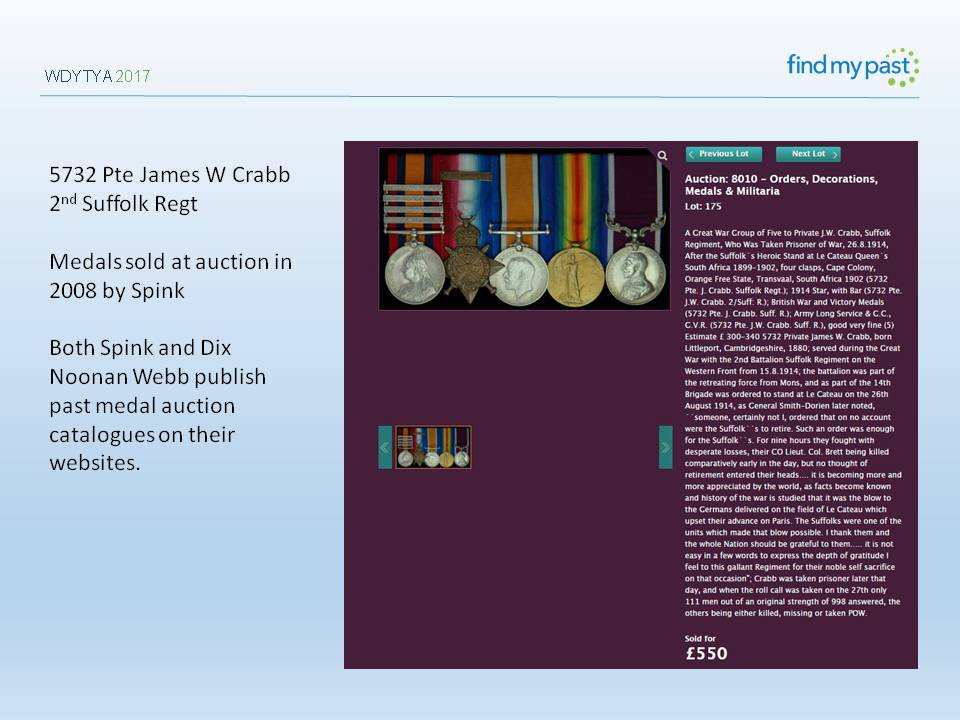
The screen grab above is from the auctioneers, Spink & Son.


Libraries probably hold out the nest hope of getting access to the Gale Cengage data. It is here that you will find images (albeit poor quality) of those lists of men who had become PoWs on or before 25th December 1914. Read more about this on my 1914 PoWs page. 


The Great War Forum is a great resource, as is The Long, Long Trail website and the Western Front Association site.


As well as the book above, also check out the British Red Cross and Order of St John Enquiry lists which are held by the IWM and which have been re-published by N&MP.


You are welcome to use and refer to these slides for your own non-commercial usage but I retain the copyright in the content and soldier images unless otherwise stated. 

And remember, I research soldiers!

2 April 2017

Identifying the 1st Sherwood Foresters in 1912


I recently purchased the Sherwood Foresters Regimental Annual for 1913 and am publishing some of the photos that appear in it, below. I have become more and more interested in military photos of late, and it's clear from correspondence that I receive that identifying ancestors in military photographs is something that interests a lot of other people too.

In 1912 the 1st Battalion, Sherwood Foresters was stationed in India and the photographs below, all of which identify the men by rank and last name only, were therefore taken in that country. Taking the first photograph below as a test case, where it has been possible to identify men further, I have added in forenames and/or regimental numbers and indicated these in bold.

My first recourse was to the 1911 census which, so my reasoning went, would probably unearth many of the men in these photos. And so it turned out. An added bonus here was that it enabled me to positively identify all of the F Company men on the 1911 census. The 1st Battalion Sherwood Foresters was enumerated by company and whilst I had guessed that these men were from F Company - because it was the sixth company to be enumerated -  it was good to see my theory proved correct.

Having first checked the 1911 census, I then looked for the same men in the medal index cards. All of these men, unless they were discharged, transferred, or died between 1912 and August 1914 would have seen service in France. The battalion shipped out of India in September 1914 and by November that year was facing the Germans in trenches at Neuve Chapelle.

Finally, understanding when the regimental numbers were issued can also help in identifying the correct man. This volume of the regimental chronicle was published in 1913. The number 11998 was issued in January 1913 but given that the usual practice would have been for soldiers, after enlistment, to train at the regimental depot, then serve with the home battalion and only after then, transfer to the overseas' battalion, I would be surprised to see numbers lower than 11739 (issued on the 3rd January 1912) appearing against any of the names below.


Standing: L-Cpl Frank Frood, 6874 L-Cpl Herbert Barks, 10861 Pte Thomas Sanderson, 10125 Pte John William Clough, 10448 L-Cpl Leonard Rear
Seated: Pte Hayward, Major Henry William Pontz, 10850 L-Cpl John Newcombe, 6780 Col-Sgt Thomas William Pritchard, Pte Harry Freeman
Cross-legged: Pte Barber, Dmr Walsh, 10120 Pte Joseph Handley, Pte Thomas Robinson, Pte Swindler


Major Henry William Poyntz, pictured above and in the team photo above this, died on Christmas Eve 1912 as the result of a shooting accident near Deolali. He was 41 years old. He had been a serving officer with the Sherwood Foresters since 1892 and left a wife and daughter.

In all the photos that follow I have included the details that appear under these photographs in the 1913 regimental annual, augmenting some with forenames, but all of these men could be researched further.


Standing: Pte William Padley, Pte Albert or William Burton, Pte Hill, Pte Combes, Pte Brown, Pte Smith, Pte Sutton
Seated: Pte Herbert Denne, Col-Sgt Brearley, L-Cpl Harry Caunt, Capt Swinhoe-Phelan, L-Cpl Wheatley, Lt Armstrong
Cross-legged:  L-Cpl Tompson, Pte Thomas Morris, Pte Albert or Frank Long, L-Cpl George Foxon, Pte John Worthy


1st Battalion cricket team, winners of Futteh Maidan Cup

Standing: L-Cpl Wheatley, Pte Samuel Cheney, Pte Geoffrey Greaves, Pte Wilkinson, Pte Maidment
Seated: Lt Richard Henry Stranger, Lt George Staple Dobbie, Lt Willesby Douglas S Brownrigg, Lt William Horatio Happell, Lt Jackson
Cross-legged: Schoolmaster Henry Rushton Cooke, Lt John Vincent Earle

Henry Rushton Cooke is recorded on the 1911 Census as belonging to the Sherwood Foresters, however I think that this is an error and that his correct corps would have been the Corps of Army Schoolmasters. He was born in 1884 and so would have been about twenty-eight years old when this photograph was taken.


Standing: L-Cpl Frank Frood, Cpl Walter Rippon, Pte Ellis, Pt Frederick or William Richards, L-Cpl Leonard Rear
Seated: Pte Feer, Major Henry William Poyntz, Pte Beardsmore, Col-Sgt Thomas William Pritchard, Pte Charles Chesterton
Cross-legged: Pte William Crampton, Pte Harry Thornley, 10934 Pte Cyrus Hoult, Pte Denison, Pte Bolton

Note how some of the men in this photo who appear in the first photo posted here, above, have adopted identical poses. Indeed, it requires good eyes to note the minor differences between the poses in this shot and the earlier one. Note in particular, L-Cpl Frank Frood, Pte Chesterton and Major Poyntz.


Standing: Pte Smith, Pte White. Pte Stevenson
Seated: Pte Arthur Corbett, Col-Sgt Charles Chambers, Capt Dixon, L-Cpl Holmes
Cross-legged: L-Cpl Potten, Pte Arthur Bowler, Pte Bignell

There is of course a lot more research that can be done for these men: other census returns, GRO records, parish records, school records and of course, various military records. Many of these men will have medal index cards, medal roll entries and service records. Others will also appear in Commonwealth War Graves records. 10934 Pte Cyrus Hoult, pictured in the football shield photo, falls into this category.  Aged 23 in 1911, he was killed in action on the 20th October 1914 whilst serving with the 2nd Battalion. This suggests that he had returned to England between 1912 and 1914, transferred to the Army Reserve and then been recalled to the colours in August 1914, going out to France with the 2nd Battalion. He has no known grave and is commemorated on the Ploegsteert Memorial.

I research soldiers!


Grab a book bargain - 1000s of titles