4 March 2009

4th Battalion, The Essex Regiment

I'm re-visiting my earlier post on Essex Regiment Territorial Force battalions and have added additional data for the 4th Essex Regiment which was headquartered at Brentwood. Over the next few days I'll add further information for the 6th, 7th and 8th Battalions.

View pre 1914-1918 and British Army WW1 Records on-line. Click the link.


Find photos of Essex Regiment soldiers on my British Army Ancestors website.


I also offer a comprehensive, fast and cost-effective military history research service. Follow the link for more information.

3 March 2009

The exception to the rule


Just when you think you've got the whole army numbering logic sorted out for a particular battalion, along comes an attestation paper - or usually several attestation papers - which completely throws you of course.

Take for instance, the example of William Buchanan who attested for one year's service with the Argyll & Sutherland Highlanders Special Reserve on 17th August 1914. His number - 4898 - belongs neither to the series being used by the 3rd and 4th Battalions at that time (they were numbering in the 7000s and 9000s respectively), nor for that matter, to the service battalions which had only just crossed 3000 by the end of August 1914.

In answer to question 10 on William's papers which reads, "Do you now belong to the Royal Navy, The Army...", the answer is written, "Yes, 13 years." Unhelpfully, the particular service to which William belonged is not recorded.

And so William Buchanan is a mystery to me. His service with the A&S Highlanders did not last long though: he was discharged from the 10th (Service) Battalion on 2nd October 1914 as medically unfit. "No teeth" is written on his attestation paper.

William's service record survives in the WO 364 (pension) series at the National Archives and although not much of it survives, what is there is interesting to read. He carried a number of tattoos on his arms: "Mrs Maybrick" on his left upper arm and "two pictures from Punch" on his left forearm. On his right arm was a "coat of arms, rose and one picture from Punch." You can almost hear the authorities checking him against the notes in the Distinctive Marks section: "Well it says here, two pictures from Punch, but I've definitely seen that in The Strand..."

Mrs Maybrick was probably Florence Maybrick (pictured on this post) who, in the late 1880s was found guilty of poisoning her husband and sentenced to death. There was a huge public outcry and she was finally released from prison after 15 years. William Buchanan appears to have been a fan.

British Army WW1 Records


I also offer a comprehensive, fast and cost-effective military history research service. Follow the link for more information.

2 March 2009

Special Reserve - 1907 Army Order - Appendices

I am posting here, the appendices to the 23rd December 1907 Army Order for the "Scheme for the provision, organization, and training of the Special Reserve..." which I posted in full the other day. My grateful thanks again to Graham Stewart for sending me these.


I also offer a comprehensive, fast and cost-effective military history research service. Follow the link for more information.

APPENDIX I
Provisional establishment of a Training Brigade, Royal Field Artillery.


APPENDIX II
Stations of Training Brigades, Royal Field Artillery, showing Special Reserve units to be affiliated.


APPENDIX IIIEstablishments for Royal Engineers reserve companies.


APPENDIX IVTables showing the Militia battalions to be converted into Reserve battalions and the Militia battalions to be disbanded.


APPENDIX VEstablishment for a 3rd (5th or 6th in the case of regiments with four line battalions) reserve battalion in peace and on mobilization, and of an infantry depot when the reserve battalion is mobilized.


APPENDIX VIEstablishment laid down for each of the 27 Extra Reserve battalions.


APPENDIX VIIEstablishment for Rifle depot (Winchester) and for four reserve rifle battalions at Woolwich; and establishment of depots at Winchester and Woolwich on mobilization.


APPENDIX VIIITable showing periods of training for the Special Reserve.


APPENDIX IX
Terms of service and standrads of height and age.


APPENDIX XPay and allowances of NCOs and men of the Special Reserve (Artillery, Engineers and Infantry).


APPENDIX XI
Daily rates of pay and allowances...


The Argyll & Sutherland Highlanders - service battalion numbers

If at times the Territorial Force army service numbers for some battalions of the Argyll & Sutherland Highlanders seem to confound logic, so too - at times - do those numbers issued to men joining the service battalions from August 1914.

By 8th June 1914, numbering in the 1st and 2nd (Regular) Battalions of the Argyll & Sutherland Highlanders had reached 1377 and when Britain went to war with Germany two months later and the 10th (Service) Battalion of the A&S Highlanders was formed in August 1914, it (and later the other service battalions too), continued with the numbering series in use by the regular battalions. The 1st and 2nd still recruited men for regular periods of enlistment (seven years with the Colours and five on the Reserve) but whereas these men's numbers carried no prefix, those joining the service battalions for war-time enlistment only, had their numbers prefixed with S/.

So in theory, S/1600 would have been an August 1914 war-time enlistment, whereas 1601 enlisted at around the same time time but as a regular, career soldier.

I list below, sample army service numbers and joining dates or date ranges for the A&S Highlanders during the First World War. There are significant gaps as you will see, and the numbers that I have listed below could give the impression that they ran sequentially and consistently. They didn't. Treat these dates with caution as there are exceptions which I'll try to point out.

It is also worth pointing out that as far as I am aware there are no patterns within the general number series which would identify a man as belonging to a particular battalion. The numbers listed below will give a rough indication of when he was likely to have joined but they are of no help in determining a battalion. Furthermore whilst the 3rd (Special Reserve) and 4th (Extra Reserve) Battalions maintained their separate numbering series in the initial months of the war, these appear to have been abandoned later. My data for these battalions only extends to October 1914 and as the war progressed it was quite common to see an S/ prefix man with a number in the service/regular battalion series, joining what had once been the Special/Extra Reserve. I'd love to see an ACI or Army Order dealing with this.

Anyway, on with the numbering:

S/3033 joined on 31st August 1914
S/5422 joined on 23rd September 1914
S/6126 joined on 29th October 1914
S/6758 joined on 25th November 1914
S/7158 joined on 26th December 1914
S/7711 joined on 18th January 1915
S/8152 joined on 27th February 1915
S/8279 joined on 10th March 1915
S/8641 joined on 28th April 1915
S/9385 joined on 27th May 1915
S/9750 joined on 27th June 1915

S/9986 joined the 14th (Service) Battalion on the 12th July 1915, but by this time, numbers in the S/121* range had already begun to appear, thus S/12155 was issued on 5th July 1915. S/12198 on 10th July 1915, S/12250 on 17th July 1915 and so on. S/12483 was issued on the 27th July 1915.

NB - see also the section below headed The return of the S/10***s

S/13186 joined on 21st August 1915
S/13565 joined on 21st September 1915
S/14141 joined on 27th October 1915

In November and December 1915, the numbering goes awry and I think for the purposes of this post, I'll just pull additional data from my database to try and illustrate this. Battalion (or D for Depot) indicated in brackets. The 13th and 15th were local reserve battalions.

S/14062 - 17th Nov 1915 (15th)
S/14100 - 8th Nov 1915 (D)
S/14109 - 24th Nov 1915 (15th)
S/14125 - 15th Nov 1915 (15th)
S/14246 - 8th Nov 1915 (13th)
S/14133 - 15th Nov 1915 (15th)
S/14170 - 2nd Nov 1915 (15th)
S/14259 - 3rd Nov 1915 (D)
S/14324 - 9th Nov 1915 (15th)
S/14352 - 9th Nov 1915 (14th)
S/14387 - 2nd Nov 1915 (15th)
S/14390 - 8th Nov 1915 (15th)
S/14438 - 22nd Nov 1915 (15th)
S/14962 - 19th Nov 1915 (15th)
S/15057 - 23rd Nov 1915 (15th)
S/15260 - 24th Nov 1915 (15th)
S/15310 - 26th Nov 1915 (15th)
S/15439 - 16th Nov 1915 (15th)

S/15156 - 1st Dec 1915 (D)
S/15164 - 1st Dec 1915 (D)
S/15292 - 10th Dec 1915 (15th)
S/15350 - 10th Dec 1915 (D)

S/15477 joined on 24th January 1916
S/16083 joined on 15th February 1916

The return of the S/10***s

In June 1915, the numbering had appeared to leap from the 97**s to the 12***s. For me, this illustrates the point that it's generally advisable to be suspicious of unexplained gaps in numbering sequences. The Argyll & Sutherland Highlanders is a case in point as these "missing" S/10*** numbers start appearing in March 1916.

Army service number S/16204 was issued to a man joining the 4th Battalion on 2nd March 1916, but by the 8th of that month, S/10256 was issued to a man (who also joined the 4th Battalion).

Numbers from S/10256 were issued, largely sequentially, through March, April and into May 1916 before the numbering returned to the 16***s in June 1916, thus:

S/10526 joined on 28th March 1916
S/11606 joined on 26th April 1916
S/11909 joined on 31st May 1916

S/16329 joined on 13th June 1916
S/16674 joined on 24th June 1916
S/16934 joined on 25th July 1916
S/17161 joined on 12th August 1916
S/17477 joined on 4th September 1916
S/17747 joined on 25th October 1916
S/18237 joined on 27th November 1916 [and again, another large jump]
S/18583 joined on 21st January 1917
S/20419 joined on 30th April 1917
S/20838 joined on 15th May 1917 [another large jump]
S/21380 joined on 14th June 1917
S/21680 joined on 18th July 1917
S/21810 joined on 4th August 1917
S/22332 joined on 18th September 1917
S/22548 joined on 22nd October 1917

My data becomes decidedly patchier from here on in; to the point where it would probably be unhelpful, rather than helpful, to publish it. So for the time being I'm going to leave service battalion numbering in the Argyll & Sutherland Highlanders at this point, and this also concludes my look at numbering patterns in the regiment as a whole. I will update posts with additional information as and when I have something useful to publish.

I also offer a comprehensive, fast and cost-effective military history research service. Follow the link for more information.

Find British Army WW1 Records by clicking this link. Also see my posts regarding army service numbers issued to men in the following Argyll & Sutherland Highlanders battalions:

1st & 2nd Argyll & Sutherland Highlanders 1881-1914
3rd (Special Reserve) & 4th (Extra Reserve) Battalion A&S Highlanders
5th Argyll & Sutherland Highlanders (TF)
6th Argyll & Sutherland Highlanders (TF)
7th Argyll & Sutherland Highlanders (TF)
8th Argyll & Sutherland Highlanders (TF)
9th Argyll & Sutherland Highlanders (TF)

1 March 2009

The Special Reserve - Army Order of 23rd December 1907


Thanks are due to Graham Stewart who has sent me much useful information in the form of Queen's and King's Regulations, Army Orders, and Army Council Instructions relating to army service numbers. I've re-published some of this information already, and my post concerning the creation of the Special Reserve in 1908 is now wonderfully augmented with a copy of the Army Order of 23rd December 1907 which dealt with the "Scheme for the provision, organization, and training of the Special Reserve required to supplement the Regular Army, and the application of the Scheme to the existing Militia".

Digging through some of my files, I also came across the image above which illustrates the choices which Militiamen were offered when the Special Reserve was created.

As can be seen, Militiamen were strongly encouraged to join the Special Reserve and a £2 bonus in 1908 would have probably been ample persuasion for many.


I also offer a comprehensive, fast and cost-effective military history research service. Follow the link for more information.

27 February 2009

9th Argyll & Sutherland Highlanders

The 9th (The Dumbartonshire) Battalion, Argyll & Sutherland Highlanders, was a Territorial Force (TF) battalion which, at the beginning of 1914, was headquartered at Dumbarton. A Company recruited men from Helensburgh, B Company from Kirkintilloch, C Company from Dumbarton, D Company from Milngavie, E Company from Jamestown, F Company from Alexandria, and G and H Companies from Clydebank.

Again, and in common with other Territorial Force battalions from this regiment, the numbering up until 1914 is not sequential. As an example, take a look at these enlistments from 1912 and 1913, place of joining indicated in square brackets.

1912 Enlistments

1501 joined on 10th January 1912 [Dumbarton]
1516 joined on 25th January 1912 [Alexandria]
1527 joined on 9th January 1912 [Jamestown]
1533 joined on 30th January 1912 [Jamestown]
1549 joined on 22nd February 1912 [Kirkintilloch]
1613 joined on 12th April 1912 [Clydebank]
1615 joined on 16th April 1912 [Alexandria]
1649 joined on 14th May 1912 [Clydebank]
1660 joined on 5th June 1912 [Clydebank]
1693 joined on 17th June 1912 [Dumbarton]

Service records for all of these 1912 and 1913 survive in the WO 363 and WO 364 series at the National Archives. They can all be viewed on-line via the Ancestry.co.uk website.


1913 Enlistments

1780 joined on 11th February 1913 [Clydebank]
1807 joined on 24th January 1913 [Dumbarton]
1825 joined on 5th February 1913 [Milngavie]
1860 joined on 12th April 1913 [Alexandria]
1861 joined on 14th April 1913 [Renton]
1893 joined on 18th March 1913 [Jamestown]
1920 joined on 1st April 1913 [Dumbarton]
1961 joined on 8th April 1913 [Renton]
2041 joined on 6th November 1913 [Helensburgh]

Renton was the location of the drill station for F Company (headquartered at Alexandria) and I'm just going to pull out the records for those Alexandria and Renton men:

1516 joined on 25th January 1912 [Alexandria]
1615 joined on 16th April 1912 [Alexandria]
1860 joined on 12th April 1913 [Alexandria]
1861 joined on 14th April 1913 [Renton]
1961 joined on 8th April 1913 [Renton]

Looking at this short sequence, 1860 and 1861 seem perfectly logical, 1861 joining two days after 1860. But bearing in mind that a Territorial Force Battalion company probably numbered no more than 125 men, give or take, in 1912; and given that recruitment was slow anyway (and had reached an all time low the previous year), recruiting 100 men into two and a half months (see 1516 and 1615 above) just isn't feasible.

If any logic was applied at all - and one assumes that it must have been - it seems more probable that companies were allocated blocks of numbers and when these were used up, they applied for another block. I should emphasize that this is all supposition on my part - and as a result of interesting communications with the webmaster of the excellent Sons of Galloway website.  

I also offer a comprehensive, fast and cost-effective military history research service. Follow the link for more information.

Also see my posts regarding army service numbers issued to men in the following Argyll & Sutherland Highlanders battalions:

1st & 2nd Argyll & Sutherland Highlanders 1881-1914
3rd (Special Reserve) & 4th (Extra Reserve) Battalion A&S Highlanders
5th Argyll & Sutherland Highlanders (TF)
6th Argyll & Sutherland Highlanders (TF)
7th Argyll & Sutherland Highlanders (TF)
8th Argyll & Sutherland Highlanders (TF)
Argyll & Sutherland Highlanders service battalions 1914-1917

26 February 2009

Army photos - an appeal


Help me to illustrate the Army Service Numbers blog.

I'll return to army service numbers issued to the Argyll & Sutherland Highlanders tomorrow. For today though, an appeal.

I like, wherever possible, to illustrate each post with a relevant image. I have done so in some instances already, using a combination of photographs and postcards in my collection as well as those that I have found on-line. Inevitably though, there will be those regiments - and as far as I am concerned, the A&S Highlanders is a good example - for which I have no image at all.

So that's my request. If anybody has suitable images that I could use for any of the battalions and regiments discussed in these posts, I'd be very happy to use them. In return, I can provide a link to the site of your choice (as long as it's non-commercial) and of course give due acknowledgement. You can drop me a line at links@chailey1914-1918.net.

The undated photograph on this post comes from my collection and shows convalescent soldiers snowballing, somewhere in England.


I also offer a comprehensive, fast and cost-effective military history research service. Follow the link for more information.

25 February 2009

8th Argyll & Sutherland Highlanders


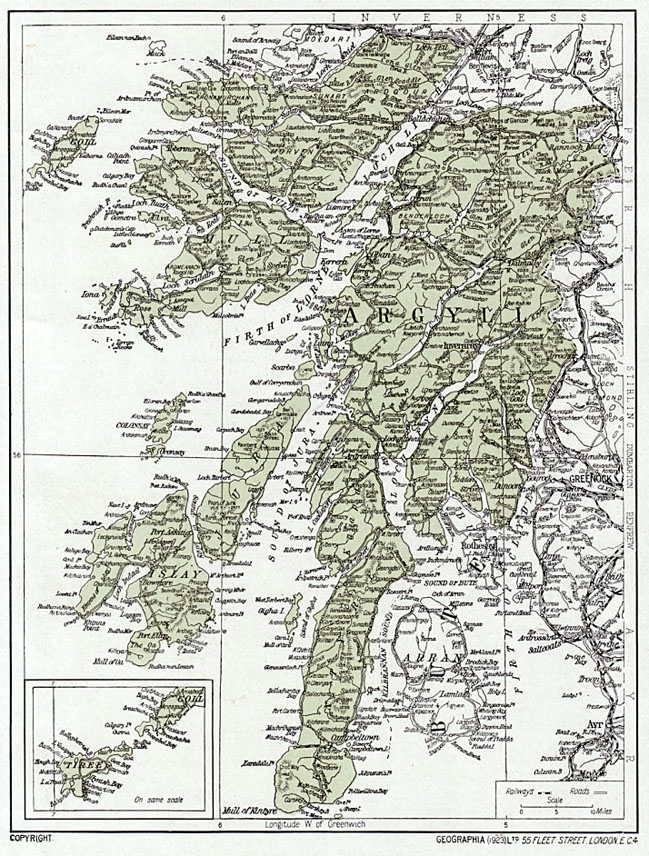
Click on the 1923 map above (courtesy of The Picture Parlour) to get a better picture of the geographical spread covered by the 8th (The Argyllshire) Battalion, Argyll & Sutherland Highlanders. This was a Territorial Force (TF) battalion which, at the beginning of 1914, was headquartered at Dunoon. A Company recruited men from Inverary, B Company from Campbeltown, C Company from Southend, D Company from Dunoon, E Company from Lochgilphead, F Company from Ballachulish, G Company from Bowmore and H Company from Easdale. (Source: The Territorial Force 1914 - Ray Westlake). All Companies, with the exception of D Company (Dunoon), had drill stations in multiple locations.

Early recruits to the 8th A&S Highlanders came from the 5th Volunteer Battalion, Argyll & Sutherland Highlanders. As with the 6th Argyll & Sutherland Highlanders, numbering in this battalion - starting from 1 in April 1908 - does not always follow a logical, sequential path and so for the time being I'm going to start the series on the Bank Holiday Monday, August 1914; the day before Britain went to war with Germany.

1791 joined on 3rd August 1914
1941 joined on 4th September 1914
2168 joined on 2nd October 1914
2316 joined on 4th November 1914
2466 joined on 7th December 1914
2592 joined on 4th January 1915
2991 joined on 1st February 1915
3240 joined on 19th March 1915
3267 joined on 6th April 1915
3331 joined on 26th May 1915 [Sup Coy]
3336 joined on 8th June 1915 [Sup Coy]
3366 joined on 5th July 1915
3411 joined on 25th August 1915
3417 joined on 1st September 1915
3468 joined on 12th October 1915
3544 joined on 25th November 1915
3658 joined on 7th December 1915
3760 joined on 8th February 1916
3864 joined on 8th May 1916
4703 joined on 28th June 1916
4748 joined on 13th July 1916
4872 joined on 8th August 1916
5096 joined on 2nd September 1916
5324 joined on 23rd October 1916
5346 joined on 11th November 1916

Note the large jump from 3864 in May 1916 to 4748 the following month. Also, throwing another spanner in the battalion's numbering works are those men from the National Reserve who attested on form E.514 for one year's service at home. Numbers 2201 and 2203 for example, both attested on 4th September 1914. Later, men joining Number 1 Supernumerary Company, attached to the 2/8th A&S Highlanders, would be given numbers that fell perfectly in the sequence being used by the battalion; see the men indicated with [Sup Coy] above.

When the Territorial Force was re-numbered in 1917, the 8th Argyll & Sutherland Highlanders were issued numbers within the range 300001 to 325000. Here are some sample six digit army service numbers from this series:

300048 originally joined on 15th March 1909
300120 originally joined on 20th February 1912
300182 originally joined on 13th January 1913
300292 originally joined on 26th January 1914
300382 originally joined on 8th August 1914
300518 originally joined on 15th September 1914
300573 originally joined on 8th October 1914
300645 originally joined on 5th November 1914
300861 originally joined on 9th January 1915
301108 originally joined on 11th February 1915
301184 originally joined on 6th April 1915
301268 originally joined on 6th September 1915
301300 originally joined on 1st November 1915
301409 originally joined on 6th December 1915
301495 originally joined on 8th February 1916
301722 originally joined on 15th May 1916
301825 originally joined on 3rd June 1916
302228 originally joined on 18th July 1916
302368 originally joined on 21st August 1916
302561 originally joined on 15th September 1916

Also see my posts regarding army service numbers issued to men in the following Argyll & Sutherland Highlanders battalions:

1st & 2nd Argyll & Sutherland Highlanders 1881-1914
3rd (Special Reserve) & 4th (Extra Reserve) Battalion A&S Highlanders
5th Argyll & Sutherland Highlanders (TF)
6th Argyll & Sutherland Highlanders (TF)
7th Argyll & Sutherland Highlanders (TF)
9th Argyll & Sutherland Highlanders (TF)
Argyll & Sutherland Highlanders service battalions 1914-1917

And finally...

BEWARE! As I have illustrated above, it is wrong to assume that numbering sequences in battalions always followed a sequential pattern. They didn't. As the war progressed and casualties grew, large numbers of men were often transferred from one battalion to another and allocated numbers within blocks which did not fit the sequential patterning seen to date. This becomes particularly evident in most battalions from 1916 onwards.
 

I also offer a comprehensive, fast and cost-effective military history research service. Follow the link for more information.

The First World War

During the Great War, The Argyllshire Battalion formed part of the 51st Division (from 12 May 1915), the 61st (2nd South Midland) Division (from 7th February 1918) and finally the 15th (Scottish) Division from 1 June 1918. The following Naval & Military re-reprints may be of interest:

FIFTEENTH (SCOTTISH) DIVISION 1914-1919


This is a fantastic book. I paid £160 for an original copy of this a few years ago. The N&MP re-print is considerably cheaper. Here's what N&MP say about the book:

"The senior of Kitchener’s Second New Army Divisions, the 15th (Scottish) was raised at Aldershot in September 1914 with a nucleus of men surplus to the requirements of the 9th (Scottish) Division and brought up to strength with drafts sent down from Scotland. It arrived in France in July 1915 and its first major battle was at Loos in which it captured its objectives, Loos itself and Hill 70, at a cost of 6, 404 casualties. All five VCs the division was to be awarded were won during the battle, four of them in twenty-four hours at Hill 70. The division remained in this sector till July 1916 when it moved down to the Somme where it achieved a notable success in capturing Martinpuich on 15th September. It took part in the Arras offensive in April 1917 and three months later it was fighting in the Battle of Pilckem Ridge during Third Ypres. It was back in the Arras sector when the German March 1918 offensive was launched and where the division held the enemy drive on Arras. For a short spell in July/August the division was under French command and took part in the capture of Buzancy and neighbouring villages. Total casualties throughout the war amounted to 45,542.

"This is an excellent history, well set out and with very good maps to support the interesting and well-written account of the division’s record. A most useful innovation is the provision of marginal notes which highlight events described in the accompanying text, and the top of each page is dated, a most welcome feature in a fast-moving narrative. A remarkable feature is the number of appendices which take up 192 pages and provide a wealth of detail: Order of Battle; Commanders and Staff both divisional and brigade with all changes; chronology of moves and events; casualties by battalions/units by dates with officers named and other ranks tabulated; complete list of recipients of Honours and Awards, by battalions/units. Of special interest are the operation orders for the Battle of Loos and the translation of a German report on the battle."


"The Highland Division was one of the pre-war Territorial divisions. Its HQ was in Perth with brigade HQs in Aberdeen, Inverness and Stirling. On mobilization the division moved down to its war station in Bedford where it remained, carrying out training till embarking for France in May 1915. During this period six of its battalions were sent to France, three in November 1914 and three in the following March, replaced by two Highland battalions and a brigade of four Lancashire battalions; it is not clear whether the latter were required to wear kilts. They were transferred to the 55th (West Lancashire) Division when that division reformed in France in January 1916 and were replaced, appropriately, by Scottish battalions. It was in May 1915, just as the division arrived in France, that it was designated 51st and the brigades 152nd, 153rd and 154th; by the end of the war the 51st (Highland) Division had become one of the best known divisions in the BEF."


"The author served in the 7th Battalion (TF) Gordon Highlanders, 153rd Brigade, 51st Highland Division, and the period covered runs from their departure for France on 3rd May 1915 to the capture of Beaumont Hamel by the division on 13th November 1916. This is partly personal reminiscence and partly an account of his brigade and division in action. Thus we have extracts from his ‘trench journal’ on various dates describing his battalion’s experiences, but these are often set against a background of the brigade or division operations. It does not replace a divisional history as such but it certainly does give a very good picture of the Highland division at war and of a Highland battalion at war. Names of personalities mentioned are for real - not pseudonyms. This is a well-written account and a very satisfactory read but lacks maps and an index."

24 February 2009

7th Argyll & Sutherland Highlanders

The 7th Battalion, Argyll & Sutherland Highlanders, was a Territorial Force (TF) battalion which, at the beginning of 1914, was headquartered at Stirling. A Company drew men from Stirling, B Company from Stenhousemuir, C Company from Falkirk, D Company from Lennoxtown, E and H Companies from Alloa, F Company from Alva and G Company from Kinross. (Source: The Territorial Force 1914 - Ray Westlake).

The battalion, formed in 1908, took in men who had previously served with the 4th Volunteer Battalion, Argyll & Sutherland Highlanders.

The numbering series used for the 7th A&S Highlanders appears to be a good deal less complicated than that used for the 6th Argyll & Sutherland Highlanders. Typically, there is an exception and that appears to be those D Company men who joined at Lennoxtown and Kilsyth (which is where the drill station for D Company was situated). Up until the end of 1911 at least, their army service numbers appear to be out of step with men joining the other companies.

The following sequences to the end of 1911 show sample army service numbers for the 7th A&S Highlanders. Locations indicated in square brackets are the places of joining. Kilsyth & Lennoxtown men in blue.

Service records for ALL of the army service numbers listed on this post, survive in the WO 363 (burnt documents) and WO 364 (penison) series at the National Archives. They can all be accessed on-line via Ancestry.co.uk

1909
880 joined on 12th January [Falkirk]
942 joined on 7th February [Kilsyth]
1006 joined on 28th January [E - Falkirk]
1016 joined on 25th March [Falkirk]
1038 joined on 8th April [Lennoxtown]
1062 joined on 4th March [Kelty]
1157 joined on 7th April [Kinross]

1910
1219 joined on 24th February [Kilsyth]
1249 joined on 9th February [E - Falkirk]
1285 joined on 23rd April [Kilsyth]
1287 joined on 23rd April [Kilsyth]
1322 joined on 16th December [Kilsyth]
1330 joined on 1st November [Falkirk]

1911
1324 joined on 16th January [Lennoxtown]
1334 joined on 20th February [Falkirk]
1349 joined on 15th March [Kilsyth]
1350 joined on 30th January [Stenhousemuir]
1353 joined on 31st January [Larbert]
1381 joined on 1st April [Kelty]
1382 joined on 11th April [Kelty]
1384 joined on 24th April [Alloa]
1403 joined on 2nd November [Lennoxtown]
1411 joined on 8th November [Lennoxtown]
1415 joined on 7th November [Kinross]

Now admittedly, what I have published above is a very small sample of army service numbers and joining dates for the 7th A&S Highlanders and I would love to see further evidence to support my theory that D Company men were - up until 1911 at least, and for want of a better term - out of kilter with the other companies. By 1912, as I say, the numbering appears to have settled down. I've added some six digit numbers into this following sequence. These were issued when the TF was re-numbered in 1917.

1912
1438 joined on 17th January [Falkirk]
1467 joined on 29th January [Larbert]
1492 joined on 2nd February [Alva]
1515 joined on 18th March [Kilsyth]
1518 joined on 18th March [Kilsyth] later re-numbered 275112
1523 joined on 20th March[Kilsyth]
1534 joined on 26th March[Kinross]
1539 joined on 26th March [Kilsyth]
1553 joined on 27th March [Kilsyth] later re-numbered 275127
1567 joined on 2nd April [Denny]
1583 joined on 18th April [Kelty]
1594 joined on 16th April [Alloa]
1624 joined on 16th May [Alloa] later re-numbered 275160
1625 joined on 17th May [Alloa]
1665 joined on 31st July [Falkirk]
1689 joined on 6th November [Kilsyth]
1701 joined on 14th November [Falkirk] later re-numbered 275196
1727 joined on 5th December [Falkirk]

Here are some further sample army service numbers for the 7th A&S Highlanders from 1913 until 1916.

1784 joined on 21st January 1913
2132 joined on 31st March 1914
2248 joined on 11th August 1914
2359 joined on 7th September 1914
3004 joined on 14th October 1914
3151 joined on 2nd November 1914
3750 joined on 1st February 1915
3821 joined on 20th March 1915
4166 joined on 22nd April 1915
4181 joined on 3rd May 1915
4329 joined on 9th June 1915
4393 joined on 27th July 1915
4433 joined on 19th August 1915
4449 joined on 11th October 1915
4598 joined on 3rd November 1915
4745 joined on 24th January 1916
4824 joined on 2nd March 1916
5018 joined on 27th April 1916
5285 joined on 18th May 1916
5519 joined on 1st June 1916
6166 joined on 4th August 1916
6511 joined on 5th September 1916
6704 joined on 23rd October 1916
6838 joined on 29th November 1916
7274 joined on 29th December 1916

When the Territorial Force was re-numbered in 1917, the 7th A&S Highlanders (as can be seen above) were issued numbers within the block 275001 to 300000.

BEWARE!
As I have illustrated above, it is wrong to assume that numbering sequences in battalions always followed a sequential pattern. They didn't. As the war progressed and casualties grew, large numbers of men were often transferred from one battalion to another and allocated numbers within blocks which did not fit the sequential patterning seen to date. This becomes particularly evident in most battalions from 1916 onwards.


I also offer a comprehensive, fast and cost-effective military history research service. Follow the link for more information.

Also see my posts regarding army service numbers issued to men in the following Argyll & Sutherland Highlanders battalions:

1st & 2nd Argyll & Sutherland Highlanders 1881-1914
3rd (Special Reserve) & 4th (Extra Reserve) Battalion A&S Highlanders
5th Argyll & Sutherland Highlanders (TF)
6th Argyll & Sutherland Highlanders (TF)
8th Argyll & Sutherland Highlanders (TF)
9th Argyll & Sutherland Highlanders (TF)
Argyll & Sutherland Highlanders service battalions 1914-1917


The First World War

Two further battalions were formed during the First World War, the 2/7th and 3/7th Argyll & Sutherland Highlanders. The original, 7th Battalion became the 1/7th and, from January 1915, formed part of the 4th Division. In March 1916 it transferred to the 51st (Highland) Division.


The Naval and Military Press has re-published the 51st Divisional History. Here's what it says:

"The Highland Division was one of the pre-war Territorial divisions. Its HQ was in Perth with brigade HQs in Aberdeen, Inverness and Stirling. On mobilization the division moved down to its war station in Bedford where it remained, carrying out training till embarking for France in May 1915. During this period six of its battalions were sent to France, three in November 1914 and three in the following March, replaced by two Highland battalions and a brigade of four Lancashire battalions; it is not clear whether the latter were required to wear kilts. They were transferred to the 55th (West Lancashire) Division when that division reformed in France in January 1916 and were replaced, appropriately, by Scottish battalions. It was in May 1915, just as the division arrived in France, that it was designated 51st and the brigades 152nd, 153rd and 154th; by the end of the war the 51st (Highland) Division had become one of the best known divisions in the BEF."

I haven't read this divisional history but I do have an original copy of Fifty-First in France which I would recommend and which has also been re-published by N&M Press:


Here's the blurb:

"The author served in the 7th Battalion (TF) Gordon Highlanders, 153rd Brigade, 51st Highland Division, and the period covered in the book runs from their departure for France on 3rd May 1915 to the capture of Beaumont Hamel by the division on 13th November 1916. This is an unusual piece of work in that it is partly personal reminiscence and partly an account of his brigade and division in action. Thus we have extracts from his ‘trench journal’ on various dates describing his battalion’s experiences, but these are often set against a background of the brigade or division operations. It does not replace a divisional history as such but it certainly does give a very good picture of the Highland division at war and of a Highland battalion at war. Names of personalities mentioned are for real - not pseudonyms. This is a well-written account and a very satisfactory read but lacks maps and an index."

Grab a book bargain - 1000s of titles