This post will look at regimental numbering in the 4th (Territorial Force) Battalion, Leicestershire Regiment between 1908 and 1914.
British regimental number research. First World War research. Military research. British Army regiments. Regimental numbering sequences between 1881 and 1918. Regimental number series. Other rank prisoners of war 1914.
23 December 2020
Leicestershire Regiment - 4th Bn (TF)
This post will look at regimental numbering in the 4th (Territorial Force) Battalion, Leicestershire Regiment between 1908 and 1914.
6 December 2020
Middlesex Regiment - 10th Bn (TF)
This is my final post on numbering in the Territorial Force battalions of the Middlesex regiment and in this post I will be looking at regimental numbering in the 10th (Territorial Force) Battalion, Middlesex Regiment between 1908 and 1914. Use the information below to estimate when your ancestor joined this particular battalion. Note that all Territorial Force battalions had their own unique number series (and for that matter, some operated more than one number series). The Middlesex Regiment had four regular battalions, one special reserve battalion, one extra reserve battalion and four Territorial Force battalions. So if your ancestor served in the 7th Battalion, 8th Battalion, or 9th Territorial Force Battalion, Middlesex Regiment, you'll need to follow those links instead. Check the site index for a list of all regimental number sequences published to date.
The 10th Middlesex Regiment was headquartered at Stamford Brook Lodge, Ravenscourt Park, Hammersmith and its eight companies drew men from the following locations:
A Company: St John's College, Battersea; B Company: St Mark's College, Chelsea; C to H Companies: Ravenscourt Park. The battalion was part of the Middlesex Infantry Brigade in the Home Counties Division.
Here are some sample regimental numbers for the 7th Middlesex Regiment. These were issued sequentially, beginning at No 1 on the 1st April 1908. The 10th Battalion had no Volunteer Force predecessor and was newly created in April 1908. Nevertheless, around 300 members of the old 2nd South Middlesex Volunteer Rifle Corps helped form the nucleus of this battalion.
84 joined on the 20th June 1908
838 joined on the 6th May 1910
1013 joined on the 20th March 1911
1069 joined on the 22nd January 1912
1438 joined on the 13th January 1913
1785 joined on the 16th February 1914
1946 joined on the 7th August 1914
2187 joined on the 1st September 1914
Use the regimental numbers above to estimate when a man would have joined this battalion between 1908 and August 1914. For example, if your man had the number 1200, he would have joined this battalion in 1912.
Remember. I research soldiers! Drop me a line if you need help
To search for photos of your Middlesex Regiment ancestors, check my British Army Ancestors website.
Middlesex Regiment - 9th Bn (TF)
In this post I will be looking at regimental numbering in the 9th (Territorial Force) Battalion, Middlesex Regiment between 1908 and 1914. Use the information below to estimate when your ancestor joined this particular battalion. Note that all Territorial Force battalions had their own unique number series (and for that matter, some operated more than one number series). The Middlesex Regiment had four regular battalions, one special reserve battalion, one extra reserve battalion and four Territorial Force battalions. So if your ancestor served in the 7th Battalion, 8th Battalion, or 10th Territorial Force Battalion, Middlesex Regiment, you'll need to follow those links instead. Check the site index for a list of all regimental number sequences published to date.
The 9th Middlesex Regiment was headquartered at Pound Lane, Willesden Green and its eight companies drew men from the following locations:
A & B Companies: Willesden Green; B Company: Barnet; C Company: Willesden, with a drill station at Stanmore; D & E Companies: Willesden; F Company: Harrow; G Company: Wealdstone; H Company: Hendon. The battalion was part of the Middlesex Infantry Brigade in the Home Counties Division.
Here are some sample regimental numbers for the 7th Middlesex Regiment. These were issued sequentially, beginning at No 1 on the 1st April 1908. The vast majority of early recruits would have been men who were serving with the 5th West Middlesex Rifle Volunteer Corps.
4 joined on the 1st April 1908
525 joined on the 5th March 1909
764 joined on the 17th October 1910
779 joined on the 24th January 1911
882 joined on the 23rd January 1912
1150 joined on the 2nd July 1913
1228 joined on the 3rd February 1914
1445 joined on the 8th August 1914
1973 joined on the 5th September 1914
Use the regimental numbers above to estimate when a man would have joined this battalion between 1908 and August 1914. For example, if your man had the number 1300 and came from Barnet, he joined in 1914, before the First World War, and would have probably served in B Company.
Remember. I research soldiers! Drop me a line if you need help
To search for photos of your Middlesex Regiment ancestors, check my British Army Ancestors website.
Middlesex Regiment - 8th Bn (TF)
In this post I will be looking at regimental numbering in the 8th (Territorial Force) Battalion, Middlesex Regiment between 1908 and 1914. Use the information below to estimate when your ancestor joined this particular battalion. Note that all Territorial Force battalions had their own unique number series (and for that matter, some operated more than one number series). The Middlesex Regiment had four regular battalions, one special reserve battalion, one extra reserve battalion and four Territorial Force battalions. So if your ancestor served in the 7th Battalion, 9th Battalion or 10th Battalion, Middlesex Regiment, you'll need to follow those links instead. Check the site index for a list of all regimental number sequences published to date.
The 8th Middlesex Regiment was headquartered at 202a Hanworth Road, Hounslow and its eight companies drew men from the following locations:
A Company: Twickenham; B Company: Brentford; C Company: Hounslow; D Company: Southall; E Company: Uxbridge; F Company: Ealing; G Company: Hampton; H Company: Staines. The battalion was part of the Middlesex Infantry Brigade in the Home Counties Division.
Here are some sample regimental numbers for the 8th Middlesex Regiment. These were issued sequentially, beginning at No 1 on the 1st April 1908. The vast majority of early recruits would have been men who were serving with the 2nd Volunteer Battalion.
320 joined on the 4th April 1908
693 joined on the 22nd February 1909
1089 joined on the 28th February 1910
1203 joined on the 11th January 1911
1698 joined on the 20th May 1912
2042 joined on the 1st May 1913
2356 joined on the 11th March 1914
2536 joined on the 1st September 1914
Use the regimental numbers above to estimate when a man would have joined this battalion between 1908 and August 1914. For example, if your man had the number 1200 and came from Staines, he probably joined in January 1911 and would have probably served in H Company which was the Staines company.
The photo on this post shows officers of the 8th Battalion and was originally published in The Tatler on the 8th February 1916.
Remember. I research soldiers! Drop me a line if you need help
To search for photos of your Middlesex Regiment ancestors, check my British Army Ancestors website.
Middlesex Regiment - 7th Bn (TF)
In this post I will be looking at regimental numbering in the 7th (Territorial Force) Battalion, Middlesex Regiment between 1908 and 1914. Use the information below to estimate when your ancestor joined this particular battalion. Note that all Territorial Force battalions had their own unique number series (and for that matter, some operated more than one number series). The Middlesex Regiment had four regular battalions, one special reserve battalion, one extra reserve battalion and four Territorial Force battalions. So if your ancestor served in the 8th Battalion, 9th Battalion or 10th Territorial Force Battalion, Middlesex Regiment, you'll need to follow those links instead. Check the site index for a list of all regimental number sequences published to date.
The 7th Middlesex Regiment was headquartered at Priory Road, Hornsey and its eight companies drew men from the following locations:
A Company: Hampstead; B Company: Barnet; C & H Company: Hornsey; D Company: Highgate; E & G Company: Tottenham; F Company: Enfield Lock, with a drill station at Enfield Town. The battalion was part of the Middlesex Infantry Brigade in the Home Counties Division.
Here are some sample regimental numbers for the 7th Middlesex Regiment. These were issued sequentially, beginning at No 1 on the 1st April 1908. The vast majority of early recruits would have been men who were serving with the 1st Volunteer Battalion.
12 joined on the 3rd April 1908
730 joined on the 16th February 1909
1163 joined on the 27th June 1910
1263 joined on the 11th January 1911
1487 joined on the 6th March 1912
1716 joined on the 20th January 1913
2097 joined on the 9th March 1914
2312 joined on the 4th August 1914
2515 joined on the 1st September 1914
Use the regimental numbers above to estimate when a man would have joined this battalion between 1908 and August 1914. For example, if your man had the number 2000 and came from Tottenham, he probably joined in early 1914 and would have probably served in one of the two Tottenham companies, E or G Company.
Remember. I research soldiers! Drop me a line if you need help
To search for photos of your Middlesex Regiment ancestors, check my British Army Ancestors website.
5 December 2020
Durham Light Infantry - 9th Bn (TF)
This post will look at regimental numbering in the 9th (Territorial Force) Battalion, Durham Light Infantry between 1908 and 1914. Use the information below to estimate when your ancestor joined this particular battalion. Note that all Territorial Force battalions had their own unique number series (and for that matter, some operated more than one number series). So if your ancestor served in the 6th Battalion, 7th Battalion or 8th Battalion, Durham Light Infantry, you'll need to follow those links instead. Check the site index for a list of all number sequences published to date.
The 8th Durham Light Infantry was headquartered at Burt Terrace, Gateshead and its eight companies drew men from the following locations:
A, B, C & D Companies: Gateshead; E Company: Felling; F Company: Chopwell; G Company: Blaydon, with a drill station at West Ryton; H Company: Blaydon. The battalion was part of the Durham Light Infantry Brigade in the Northumbrian Division.
Here are some sample regimental numbers for the 9th Durham Light Infantry. These were issued sequentially, beginning at No 1 on the 1st April 1908. The vast majority of early recruits would have been men who were serving with the 5th Volunteer Battalion.
100 joined on the 14th April 1908
620 joined on the 30th March 1909
1022 joined on the 14th April 1910
1188 joined on the 25th April 1911
1256 joined on the 29th January 1912
1518 joined on the 15th April 1913
2046 joined on the 1st May 1914
2146 joined on the 8th August 1914
Use the regimental numbers above to estimate when a man would have joined this battalion between 1908 and August 1914. For example, if your man had the number 1600 and came from Felling, he would have joined in 1913 and would have probably served in E Company.
Remember. I research soldiers! Drop me a line if you need help
To search for photos of your Durham Light Infantry ancestors, check my British Army Ancestors website.
Durham Light Infantry - 8th Bn (TF)
This post will look at regimental numbering in the 8th (Territorial Force) Battalion, Durham Light Infantry between 1908 and 1914. Use the information below to estimate when your ancestor joined this particular battalion. Note that all Territorial Force battalions had their own unique number series (and for that matter, some operated more than one number series). So if your ancestor served in the 6th Battalion or the 7th Battalion, Durham Light Infantry, you'll need to follow those links instead. Check the site index for a list of all number sequences published to date.
The 8th Durham Light Infantry was headquartered at Gilesgate, Durham and its eight companies drew men from the following locations:
A Company: Gilesgate, with drill stations at Sherburn Hill, Brandoin and Sacriston; B Company: Gilesgate; C Company: Chester-le-Street; D Company: Birtley; E Company: Beamish with a drill station at Burnhope; F Company: Stanley; G Company: Houghton-le-Spring, with drill stations at Pittington and Washington; H Company: Hamsteels, with drill stations at Langley Park & Sleetburn. The battalion was part of the Durham Light Infantry Brigade in the Northumbrian Division.
Here are some sample regimental numbers for the 8th Durham Light Infantry. These were issued sequentially, beginning at No 1 on the 1st April 1908. The vast majority of early recruits would have been men who were serving with the 4th Volunteer Battalion.
49 joined on the 1st April 1908
984 joined on the 17th March 1909
1341 joined on the 24th February 1910
1615 joined on the 27th January 1911
1815 joined on the 2nd April 1912
2018 joined on the 24th February 1913
2449 joined on the 24th March 1914
2611 joined on the 4th September 1914
Use the regimental numbers above to estimate when a man would have joined this battalion between 1908 and August 1914. For example, if your man had the number 1500 and came from Pittington, he would have joined in 1912 and would have probably served in G Company.
Remember. I research soldiers! Drop me a line if you need help
To search for photos of your Durham Light Infantry ancestors, check my British Army Ancestors website.
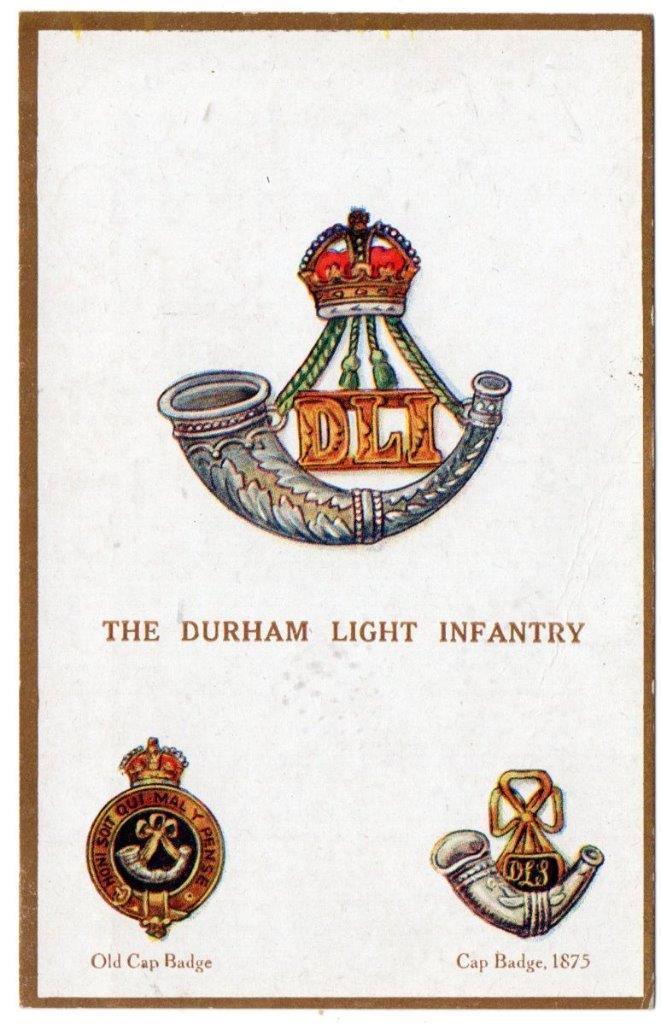
Durham Light Infantry - 7th Bn (TF)
This post will look at regimental numbering in the 7th (Territorial Force) Battalion, Durham Light Infantry between 1908 and 1914. Use the information below to estimate when your ancestor joined this particular battalion. Note that all Territorial Force battalions had their own unique number series (and for that matter, some operated more than one number series). So if your ancestor served in the 6th Battalion, Durham Light Infantry, this post won't be for you. Follow the link for the 6th Battalion.
The 7th Durham Light Infantry was headquartered at Livingstone Road, Sunderland and its eight companies drew men from the following locations:
A to F Companies: Sunderland; G & H Companies: South Shields. The battalion was part of the Durham Light Infantry Brigade in the Northumbrian Division.
Here are some sample regimental numbers for the 7th Durham Light Infantry. These were issued sequentially, beginning at No 1 on the 1st April 1908. The vast majority of early recruits would have been men who were serving with the 3nd (Sunderland) Volunteer Battalion.
288 joined on the 30th April 1908
873 joined on the 1st May 1909
1129 joined on the 31st March 1910
1344 joined on the 11th January 1911
1562 joined on the 24th April 1912
1860 joined on the 2nd June 1913
2099 joined on the 1st May 1914
2315 joined on the 7th August 1914
Use the regimental numbers above to estimate when a man would have joined this battalion between 1908 and August 1914. For example, if your man had the number 1500 and came from South Shields, he probably joined in the first quarter of 1912 and would have probably served in G or H Company.
Remember. I research soldiers! Drop me a line if you need help
To search for photos of your Durham Light Infantry ancestors, check my British Army Ancestors website.
7 November 2020
Durham Light Infantry - 6th Bn (TF)
This post will look at regimental numbering in the 6th (Territorial Force) Battalion, Durham Light Infantry between 1908 and 1914. Use the information below to estimate when your ancestor joined this particular battalion. Note that all Territorial Force battalions had their own unique number series (and for that matter, some operated more than one number series). So if your ancestor served in the 7th Battalion, Durham Light Infantry, this post won't be for you. Nothing to see here, move along...
The 6th Durham Light Infantry was headquartered at Bishop Auckland and its eight companies drew men from the following locations:
A Company: Bishop Auckland, with a drill station at Coundon; B Company: Bishop Auckland with a drill station at West Auckland; C Company: Spennymore; D Company: Crook, with a drill station at Willington; E Company: Stanhope, with drill stations at Rookhope and Wolsingham; F Company: Barnard Castle, with a drill station at Staindrop; G & H Companies drew men from Consett. The battalion was part of the Durham Light Infantry Brigade in the Northumbrian Division.
Here are some sample regimental numbers for the 6th Durham Light Infantry. These were issued sequentially, beginning at No 1 on the 1st April 1908. The vast majority of early recruits would have been men who were serving with the 2nd Volunteer Battalion.
192 joined on the 7th April 1908
1005 joined on the 30th March 1909
1161 joined on the 21st February 1910
1317 joined on the 26th January 1911
1531 joined on the 29th March 1912
1786 joined on the 8th February 1913
2003 joined on the 2nd March 1914
2238 joined on the 7th August 1914
Use the regimental numbers above to estimate when a man would have joined this battalion between 1908 and August 1914. For example, if your man had the number 1500 and came from Crook, he would have joined in the first quarter of 1912 and would have probably served in D Company.
Remember. I research soldiers! Drop me a line if you need help
To search for photos of your Durham Light Infantry ancestors, check my British Army Ancestors website.
Royal Warwickshire Regiment - 8th Bn (TF)
This post will look at regimental numbering in the 8th (TF) Battalion, Royal Warwickshire Regiment between 1908 and 1914.
The 8th Battalion was an entirely new Territorial Force unit, formed in 1908. It had no Volunteer Force battalion predecessor. In that year, as The Territorial Year Book for 1909 records, the 8th Battalion strength comprised 21 officers and 715 men. 630 men trained at camp that year for eight days, whilst 375 trained for 15 days. Sergeant E Robins, was the best shot of the battalion that year.
The following year, The Territorial Year Book for 1910 recorded that the strength of the 8th Battalion had risen to 25 officers and 970 men. At Brockenhurst camp that year, 362 men trained for eight days, and 584 trained for 15 days. Drummer Taylor of C Company was the best shot of the battalion in 1909.
The battalion was headquartered at Aston Manor, Birmingham, and with the exception of B Company (which recruited men from Saltley), A to H Companies all drew their men from Birmingham. ''D' Company, according to the Illustrated News in 1909, stood for 'Dunlop' Company as it was, in 1909 at least, composed exclusively of the employees of the Dunlop Tyre and Rubber companies. Pre 1914-1918 the battalion formed part of the Warwickshire Infantry Brigade in the South Midland Division.
Here are some sample regimental numbers and joining dates for the the 8th Battalion, Royal Warwickshire Regiment:
177 joined on the 22nd April 1908
964 joined on the 17th May 1909
1179 joined on the 3rd February 1910
1305 joined on the 16th March 1911
1482 joined on the 9th May 1912
1709 joined on the 16th January 1913
2196 joined on the 16th April 1914
2302 joined on the 6th August 1914
Use the regimental numbers above to estimate when a man would have joined this battalion between 1908 and August 1914. For example, if your man had the number 1000 and came from Saltley, he would have joined between May 1909 and February 1910 and would have almost certainly have served with B Company.
Remember. I research soldiers! Drop me a line if you need help
To search for photos of your Royal Warwickshire Regiment ancestors, check my British Army Ancestors website.
27 October 2020
Royal Warwickshire Regiment - 7th Bn (TF)
This post will look at regimental numbering in the 7th (TF) Battalion, Royal Warwickshire Regiment between 1908 and 1914.
The 7th Battalion was a Territorial Force unit which had been formed out of the old 2nd Volunteer Battalion. In 1908, as The Territorial Year Book for 1909 records, the 7th Battalion strength comprised 24 officers and 808 men. The following year, The Territorial Year Book for 1910 recorded that the strength of the 7th Battalion had risen to 23 officers and 980 men.
The battalion was headquartered at Coventry, and A, B, C & D Companies all drew their recruits from Coventry. E Company recruited in Rugby, F Company recruited in Leamington, G Company recruited in Warwick (and had a drill station at Kenilworth), and H Company recruited in Nuneaton. Pre 1914-1918 the battalion formed part of the Warwickshire Infantry Brigade in the South Midland Division. Here are some sample regimental numbers and joining dates for the the 7th Battalion, Royal Warwickshire Regiment:
935 joined on the 6th April 1908
1106 joined on the 1st March 1909
1280 joined on the 18th July 1910
1325 joined on the 8th February 1911
1484 joined on the 26th February 1912
1756 joined on the 14th March 1913
2110 joined on the 18th February 1914
2678 joined on the 5th September 1914
Use the
regimental numbers above to estimate when a man would have joined this
battalion between 1908 and August 1914. For example, if your man had the number
1500 and came from Coventry, he would have joined in, approximately, March 1913
and would have served in A, B, C or D Company.
Remember. I research soldiers! Drop me a line if you need help
To search for photos of
your Royal Warwickshire Regiment ancestors, check my British Army Ancestors website.
Royal Warwickshire Regiment - 5th & 6th Bns (TF)
This post will look at regimental numbering in the 5th & 6th (TF) Battalions, Royal Warwickshire Regiment between 1908 and 1914.The 5th & 6th Battalions were Territorial Force units which were formed as independent infantry battalions on the 1st April 1908. They had formerly been the 1st Volunteer Battalion which, prior to the transfer to the Territorial Force, had comprised no fewer than 18 separate companies and between 1800 and 1900 men. In 1908, as The Territorial Year Book for 1909 records, the 5th Battalion strength comprised 24 officers and 808 men, whilst the 6th Battalion comprised 24 officers and 845 men.
The following year, The Territorial Year Book for 1910 recorded that the strength of the 5th Battalion had risen to 30 officers and 957 men whilst the 6th Battalion, matching the 5th almost man for man, had a strength of 29 officers and 954 men. Both battalions were headquartered at Thorp Street, Birmingham, and all companies (companies A-H) in both battalions, recruited in Birmingham.
Here are some sample regimental numbers and joining dates for the the 5th Battalion, Royal Warwickshire Regiment:
136 joined on the 8th April 1908
581 joined on the 25th January 1909
1232 joined on the 25th February 1910
1361 joined on the 24th February 1911
1501 joined on the 26th January 1912
1819 joined on the 24th January 1913
2318 joined on the 22nd May 1914
2445 joined on the 1st September 1914
For the 6th Battalion:
1 joined on the 1st April 1908
1250 joined on the 11th March 1910
1360 joined on the 17th February 1911
1511 joined on the 26th January 1912
2110 joined on the 6th June 1913
2252 joined on the 27th March 1914
2400 joined on the 13th August 1914
2651joined on the 2nd September 1914
As can be seen from the patterns above, the battalions pretty much kept pace with each other in the years up until 1914; on the 26th January 1912 the 6th battalion had issued just ten numbers more than the 5th Battalion!
Use the regimental numbers above to estimate when a man would have joined this battalion between 1908 and August 1914. For example, if your man had the number 2000 and served with the 5th Battalion, he’d have joined the battalion between January 1913 and May 1914. The same number would have been issued to a 6th Battalion man between January 1912 and June 1913.
Remember. I research soldiers! Drop me a line if you need help
To search for photos of your Royal Warwickshire Regiment ancestors, check my British Army Ancestors website.
25 October 2020
Northumberland Fusiliers - 6th (City) Battalion (Territorial Force)
This post will look at regimental numbering in the 6th (City) Battalion (TF), Northumberland Fusiliers between 1908 and 1914.
The 6th Battalion was a Territorial Force unit which was formed on the 1st April 1908. This had formerly been the 3rd Volunteer Battalion. In 1908, as The Territorial Year Book for 1909 records, the battalion strength comprised 25 officers and 680 men. 247 men attended camp in 1908 for 8 days and 436 attended for 15 days.
The following year, The Territorial Year Book for 1910 recorded that the strength of the battalion in 1909 had risen to 29 officers and 884 men. At the annual camp that year, 242 officers and men attended for eight days whilst 630 officers and men attended for 15 days.
The battalion was headquartered at Northumberland Road, Newcastle-on-Tyne and all companies drew men from the City of Newcastle.
Here are some sample regimental numbers and joining dates for the the 6th Battalion, Northumberland Fusiliers. The majority of men signing up from April 1908 would have been men who, up until the 31st March, had been serving members of the 2nd VF Battalion.
482 joined on the 9th April 1908
1015 joined on the 3rd May 1909
1329 joined on the 29th August 1910
1420 joined on the 14th April 1911
1560 joined on the 22nd April 1912
1790 joined on the 15th May 1913
1875 joined on the 22nd January 1914
2500 joined on the 16th September 1914
As can be seen from the patterns above, recruitment was steady throughout this period, and would continue to be strong during the First World War.
A reserve or ‘second-line’ battalion was formed at Blyth in December 1914, the original 6th Battalion now becoming the 1/6th Battalion and the new reserve battalion becoming the 2/6th Battalion. A 3/6th Battalion would be formed in June 1915. Neither the 2/6th nor the 3/6th Battalion would serve overseas, rather training men who were then sent overseas as part of drafts for the 1/6th Battalion.
Use the regimental numbers above to estimate when a man would have joined this battalion between 1908 and August 1914. For example, if he had the number 1234 he would have joined this battalion at some time between May 1909 and August 1910.
Remember. I research soldiers! Drop me a line if you need help
To search for photos of your Northumberland Fusiliers ancestors, check my British Army Ancestors website.
Northumberland Fusiliers - 5th Battalion (Territorial Force)
This post will look at regimental numbering in the 5th (TF) Battalion, Northumberland Fusiliers between 1908 and 1914.
The 5th
Battalion was a Territorial Force unit which was formed on the 1st April 1908. This had formerly been the 2nd Volunteer
Battalion. In 1908, as The Territorial Year Book for 1909 records, the
battalion strength comprised 22 officers and 621 men. 189 men attended
camp in 1908 for 8 days and 406 attended for 15 days.
The following year, The Territorial Year Book for 1910 recorded that the
strength of the battalion in 1909 had risen to 30 officers and 893 men. Colour-Sergeant
Armstrong of A Company was the best shot of the battalion and at the annual
camp at Berwick in 1909, 212 officers and men attended for eight days whilst 677
officers and men attended for 15 days.
The battalion was headquartered at Walker, Newcastle-on-Tyne and drew men from
the following areas:
A, B and C Companies recruited in Walker, and D E and F Companies recruited in Wallsend. G and H Companies recruited in Gosforth, with G Company having drill stations at West Moor and Seaton Burn.
Here are some sample regimental numbers and
joining dates for the the 5th Battalion, Northumberland Fusiliers. The
majority of men signing up from April 1908 would have been men who, up until
the 31st March, had been serving members of the 2nd VF Battalion.
102 joined on the 3rd April 1908
657 joined on the 18th January 1909
1035 joined on the 3rd March 1910
1163 joined on the 1st February 1911
1352 joined on the 8th February 1912
1757 joined on the 3rd April 1913
2010 joined on the 9th March 1914
2245 joined on the 10th August 1914
As can be seen from the patterns above, recruitment was steady throughout this period, and would continue to be strong during the First World War.
A reserve or ‘second-line’ battalion was formed at Blyth in November 1914, the
original 5th Battalion now becoming the 1/5th Battalion and the new reserve
battalion becoming the 2/5th Battalion. A 3/5th Battalion would be formed in
June 1915. Neither the 2/5th nor the 3/5th Battalion would serve overseas,
rather training men who were then sent overseas as part of drafts for the 1/5th
Battalion.
Use the regimental numbers above to estimate when a man would have joined this
battalion between 1908 and August 1914. For example, if your man had the number
800 and lived in the West Moor area, he would have joined this battalion at
some time between January 1909 and March 1910, and furthermore he would probably
have served with G Company.
Remember. I research soldiers! Drop me a line if you need help
To search for photos of
your Northumberland Fusiliers ancestors, check my British Army Ancestors website.
24 October 2020
Northumberland Fusiliers - 7th Battalion (Territorial Force)
This post will look at regimental numbering in the 7th (TF) Battalion, Northumberland Fusiliers between 1908 and 1914.
The 7th
Battalion was a Territorial Force unit which was formed on the 1st April 1908. This was an entirely new formation and had no
Volunteer Force predecessor. In 1908, as The Territorial Year Book for 1909
records, the battalion strength comprised 14 officers and 580 men. 177 men
attended camp in 1908 for 8 days and 177 attended for 15 days.
The following year, The Territorial Year Book for 1910 recorded that the
strength of the battalion in 1909 had risen to 17 officers and 742 men. At the
annual camp in 1909, 181 officers and men attended for eight days whilst an
impressive 490 officers and men attended for 15 days.
The battalion was headquartered at Alnwick and drew men from the following
areas:
A Company recruited in Morpeth. B Company recruited in Ashington. C Company recruited in Belford and had drill stations at Ford, Wooler and Chatton. D Company recruited in Alnwick. E Company recruited in Amble, with drill stations at Broomhill and Warkworth. F Company also recruited at Alnwick and had a drill station at Rothbury. G Company recruited in Berwick-on-Tweed, as did H Company which also had a drill station at Scremerston.
Here are some sample regimental numbers and
joining dates for the the 7th Battalion, Northumberland Fusiliers.
149 joined on the 7th April 1908
709 joined on the 18th February 1909
849 joined on the 5th May 1911
1307 joined on the 1st November 1912
1467 joined on the 20th February 1913
1656 joined on the 15th April 1914
1799 joined on the 6th August 1914
As can
be seen from the patterns above, recruitment was patchy with just 140 men
recruited between February 1909 and May 1911, and then a surge in recruiting
between May 1911 and November 1912 which saw over 450 men signing up.
A reserve or ‘second-line’ battalion was formed at Alnwick in September 1914,
the original 7th Battalion now becoming the 1/7th Battalion and the new reserve
battalion becoming the 2/7th Battalion. A 3/7th Battalion would be formed in
June 1915. The 2/7th Battalion would later serve overseas in Egypt as a
Garrison Battalion from 1917, but the 3/7th Battalion never served overseas,
rather training men who were then sent overseas as part of drafts for the 1/7th
and 2/7th Battalions.
Use the regimental numbers above to estimate when a man would have joined this
battalion between 1908 and August 1914. For example, if your man had the number
1500 and lived in the Morpeth area, he would have joined this battalion at some
time between February 1913 and April 1914 and furthermore, he would probably
have served with A Company.
Remember. I research soldiers! Drop me a line if you need help
To search for photos of
your Northumberland Fusiliers ancestors, check my British Army
Ancestors website.
Northumberland Fusiliers - 4th Battalion (Territorial Force)
This post will look at regimental numbering in the 4th (TF) Battalion, Northumberland Fusiliers between 1908 and 1914.
The 4th Battalion was a Territorial Force unit which was formed on the 1st April 1908 and, prior to this, had been the 1st Volunteer Battalion, Northumberland Fusiliers. In 1908, as The Territorial Year Book for 1909 records, the battalion strength comprised just 17 officers and 388 men. 305 men attended camp in 1908 for 8 days and 61 attended for 15 days.
The following year, The Territorial Year Book for 1910 recorded that the
strength of the battalion in 1909 had risen to 19 officers and 548 men. At the
annual camp at Berwick that year, 72 officers and men attended for eight days
whilst 360 officers and men attended for 15 days.
The battalion was headquartered at Hexham and drew men from the following
areas:
A Company: recruited in Hexham, with a drill station at Acomb. B Company: recruited at Bellingham with drill stations at Plashett, Otterburn & Woodburn. C Company: recruited at Haydon Bridge with drill stations at Allendale, Langley and Newburgh. D Company: recruited at Prudhoe with a drill station at Mickley. E Company: recruited in Corbridge. F Company: recruited at Haltwhistle. G Company: recruited in Newburn, with a drill station at Whorlton. H Company recruited at Prudhoe.
Here are some sample regimental numbers and
joining dates for the the 4th Battalion, Northumberland Fusiliers. The
majority of men signing up from April 1908 would have been men who, up until
the 31st March, had been serving members of the 1st VF Battalion.
330 joined on the 20th May1908
398 joined on the 22nd January 1909
681 joined on the 17th May 1910
826 joined on the 28th February 1911
976 joined on the 4th April 1912
1190 joined on the 17th April 1913
1291 joined on the 9th January 1914
1461 joined on the 6th August 1914
A reserve or ‘second-line’ battalion was formed at Blyth in November 1914, the
original 4th Battalion now becoming the 1/4th Battalion and the new reserve
battalion becoming the 2/4th Battalion. The photo on this post shows men of the 1/4th Battalion in November 1914. A 3/4th Battalion would be formed in
June 1915. Neither the 2/4th nor the 3/4th Battalion served overseas, rather training
men who were then sent overseas as part of drafts for the 1/4th Battalion.
Use the regimental numbers above to estimate when a man would have joined this
battalion between 1908 and August 1914. For example, if your man had the number
500 and lived in the Corbridge area, he would have joined this battalion at
some time between the 22nd January 1909 and the 17th May 1910.
Furthermore, he would have served with E Company.
And finally... to search for photos of
your Northumberland Fusiliers ancestors, check my British Army
Ancestors website.
22 July 2020
King's (Liverpool Regiment) - 7th Battalion (TF)
The 7th Battalion was a Territorial Force unit which was formed on the 1st April 1908 and, prior to this, had been the 4th Volunteer Battalion, the King's Liverpool Regiment. In 1908, as The Territorial Year Book for 1909 records, the battalion strength comprised 32 officers and 602 men. 217 men attended camp in 1908 for 8 days and 255 attended for 15 days.
The following year, The Territorial Year Book for 1910 recorded that the strength of the battalion in 1909 stood at 25 officers and 866 men; a good increase on the previous year. At the annual camp that year, 303 officers and men attended for eight days whilst 348 officers and men attended for 15 days.
The battalion was initially headquartered at 77 Shaw Street, Liverpool; later at 99 Park Street, Bootle, and recruited in Bootle , Southport, Formby and Crosby as below:
A, B, C, D and F Companies: recruited in Bootle
E Company: recruited in Crosby
G & H Company: recruited in Southport, with a drill station at Formby
Here are some sample regimental numbers and joining dates for the the 7th Battalion, King's (Liverpool Regiment). The majority of men signing up from April 1908 would have been men who, up until the 31st March, had been serving members of the 4th VF Battalion.
141 joined on the 2nd April 1908
853 joined on the 8th March 1909
1098 joined on the 31st March 1910
1151 joined on the 25th February 1911
1297 joined on the 9th March 1912
1639 joined on the 6th February 1913
1955 joined on the 19th March 1914
2051 joined on the 4th August 1914
The battalion does not appear to have had any trouble recruiting and with the outbreak of war in August 1914, a reserve battalion was formed in Bootle in October 1914. The original 7th Battalion now became the 1/7th Battalion and the new reserve battalion became the 2/7th Battalion. A 3/7th Battalion would be formed in May 1915.
Use the regimental numbers above to estimate when a man would have joined this battalion between 1908 and August 1914. For example, if your man had the number 1678 he would have joined this battalion at some time between 6th February 1913 and 19th March 1914 (and probably in about April 1913).


