10 February 2014

Liverpool Pals


For the most part, the number blocks allocated to the initial contingents of the first four battalions of the Liverpool Pals are well defined. However, there is a series of 100 numbers between 21900 and 21999 (where the number series proper for the 20th Bn / 4th Liverpool Pals begins) which leaps about a little and includes men from the 17th (1st Pals), 18th (2nd Pals) and 20th (4th Pals) Battalions.  
 
The list below shows number, rank (taken from medal index cards), forename and last name. I've copied this directly from my Liverpool Pals' database.  Numbers with no entry against them indicate that I could find no MIC.  Entries in bold indicate a surviving service record in WO 363 or WO 364 (all available on Ancestry). I would be grateful for assistance in filling in the gaps. 

21900PteArnold HenryWalker
21901  
21902PteDavidCorry
21903PteCharles FNewman
18th Bn21904CplJohn CRoutledge
21905PteWalterFortune
21906  
21907PteThomasGeorge
21908PteWilliamStott
21909PteAlbert EdJones
18th Bn21910PteErnestPhillips
18th Bn21911PteAndrew CampbellWood
18th Bn21912PteThomas H Rosbotham
18th Bn21913PteJohnStockley
21914PteJohnHeyes
21915PteWilliamHeyes
21916  
21917PteHerbert REdwards
18th Bn21918PteBenjamin ArthurJackson
21919  
21920  
21921  
21922  
21923  
21924  
21925  
21926PteThomasHolman
21927PteJ HTaylor
18th Bn21928PteRobert ArmourBell
21929PteAlexander  Maude
21930PteJames WUnsworth
21931  
17th Bn
21932PteCyril Charles HollandAhier
21933PteCharlesStapley
21934PteBernard HSpice
21935PteArthur AngusMcLean
21936PteWilliam HMason
17th Bn
21937PteGeorge FrederickWright
21938PteGeorge HMills
17th Bn
21939PteAlfredTaylor
20th Bn21940PteThomasAckerley
20th Bn21941PtePercyBraham
21942PteJohnButt
21943PteJohn CoryCarr
20th Bn21944PteEdwardCharnock
21945PteFred WCheesbrough
20th Bn21946PteJohn RDawson
21947  
21948PteGeorgeEllis 
21949  
21950PteLawrence A VFish
20th Bn21951A/CplAlfredGreenwood
17th Bn
21952PteCharlesGilroy
17th Bn
21953PteFrederickGrundy
21954  
21955PteFrank CHarrison
21956  
21957PteLeo FrancisHeyes
21958  
17th Bn
21959PteS TalbotJones
21960PteHerbert EJones
20th Bn21961PteJohnLitchfield
21962  
18th Bn21963PteFrederickMeek
21964  
21965PteFrederick C Morgan
21966PteFrankOldfield
21967  
21968PtePercyParkinson
21969PteEdwardRoberts
21970  
21971  
21972PteJohnWilliams
17th Bn
21973PteSeymour GlynneWeston
21974OswaldWinfield
20th Bn21975PteHarold Barker
17th Bn
21976PteMatthew FloodJackson
21977  
21978  
21979PteJohnRalph
21980PteRichard NevilleSpong
21981SgtThomas Teare
21982PteWilliam RMears
21983PteSamuelBarker
21984  
21985SgtCharles EMaddox
18th Bn21986WalterLloyd
21987PteWilliamIrving
21988PteThomasCunnett
21988PteWilliam HNichols
18th Bn21989PteEdwardMorris
21990PteJoseph EdBlackmore
21991  
21992PteFrederick Downham
17th Bn
21993PteRobertBeggs
21994PteArthur  Biddles
21995  
17th Bn
21996PteJohnO'Sullivan
21997  
17th Bn
21998PteFrederick IvanPulford
21999PteEdward GerrardAustin
 

The image on this post comes from The Liverpool Organic Brewery which, in turn, draws attention to the fund to pay for a permanent memorial to the Liverpool Pals.  Read more about this on the Liverpool Pals Memorial Fund website.

Also see my post on Liverpool Pals battalions and number series.

I also offer a comprehensive, fast and cost-effective military history research service. Follow the link for more information.

9 February 2014

13th Hussars


This post will look at numbering in the 13th Hussars between 1881 and 1904 (I have no data at all for 1905 and 1906 when numbering by cavalry regiment ceased).

The database and information on this blog have been compiled as a result of studying service records in WO 97 (British Army pensions to 1913), WO 363 (WW1 service records) and WO 364 (WW1 pension records). All of these series are now online. Click on the links for further information.

2031 joined on 16th June1881
2061 joined on 12th January 1882
2106 joined on 10th February 1883
2149 joined on 27th September 1884
2314 joined on 9th February 1885
2394 joined on 22nd January 1886
2782 joined on 7th October1887
2856 joined on 30th August 1888
2895 joined on 24th February 1889
2985 joined on 9th January 1890
3125 joined on 28th January 1891
3188 joined on 19th February 1892
3338 joined on 24th March 1893
3446 joined on 20th September 1894
3502 joined on 5th January1895
3688 joined on 1st January 1896
3859 joined on 25th April 1897
4132 joined on 29th September 1898
4214 joined on 4th January 1899
5384 joined on 24th April 1900
5801 joined on 24th April 1901
6252 joined on 21st January 1902
6459 joined on 30th April 1903
6819 joined on 13th August 1904

In December 1906, Army Order 289 changed the numbering for cavalry of the line. Prior to this, all cavalry regiments had numbered individually by regiments. Now, line cavalry and household cavalry were separated; each of the three line cavalry corps – dragoons, hussars, and lancers – beginning a new number series which started at 1 and was to extend to 49,999.

What this meant for the 10th Hussars was that from late December 1906 they began a new number sequence which they shared with the all of the Hussars regiments:

3rd (King's Own) Hussars
4th (Queen's Own) Hussars
7th (Queen's Own) Hussars
8th (King's Royal Irish) Hussars
10th (Prince of Wales's Own Royal) Hussars
11th (Prince Albert's Own) Hussars
14th (King's) Hussars
15th (King's) Hussars
18th (Queen Mary's Own) Hussars
19th (Queen Alexandra's Own Royal) Hussars
20th Hussars

See also, my posts on numbering in the Corps of Hussars 1907-1914, Queen's and King's Regulations: regimental numbering and cavalry numbering in 1906.

I also offer a comprehensive, fast and cost-effective military history research service. Follow the link for more information.

11th (Prince Albert's Own) Hussars


This post will look at numbering in the 11th (Prince Albert's Own) Hussars between the years 1881 and 1906. The cavalry regiments were not affected by Cardwell's Army reforms; however, in keeping with the parameters of this blog, my starting point for this post is 1881.

The database and information on this blog have been compiled as a result of studying service records in WO 97 (British Army pensions to 1913), WO 363 (WW1 service records) and WO 364 (WW1 pension records). All of these series are now online. Click on the links for further information.

1958 joined on 10th October 1881
1968 joined on 9th January 1882
2100 joined on 5th February 1883
2295 joined on 11th April 1884
2427 joined on 29th August 1885
2454 joined on 11th March 1886
2655 joined on 7th January 1887
2852 joined on 14th April 1888
3091 joined on 11th October 1889
3200 joined on 26th June 1890
3261 joined on 4th April 1891
3466 joined on 26th February 1892
3627 joined on 31st January1893
3730 joined on 1st January1894
3954 joined on 31st January1895
4099 joined on 22nd September 1896
4146 joined on 1st March 1897
4189 joined on 16th September 1898
4216 joined on 9th February 1899
4351 joined on 9th January 1900
4657 joined on 11th January 1901
4956 joined on 25th March 1902
5183 joined on 1st December1903
5250 joined on 20th February 1904
5596 joined on 20th January 1905
5918 joined on 10th July 1906


In December 1906, Army Order 289 changed the numbering for cavalry of the line. Prior to this, all cavalry regiments had numbered individually by regiments. Now, line cavalry and household cavalry were separated; each of the three line cavalry corps – dragoons, hussars, and lancers – beginning a new number series which started at 1 and was to extend to 49,999.

What this meant for the 11th Hussars was that from late December 1906 they began a new number sequence which they shared with the all of the Hussars regiments:

3rd (King's Own) Hussars
4th (Queen's Own) Hussars
7th (Queen's Own) Hussars
8th (King's Royal Irish) Hussars
10th (Prince of Wales's Own Royal) Hussars
13th Hussars
14th (King's) Hussars
15th (King's) Hussars
18th (Queen Mary's Own) Hussars
19th (Queen Alexandra's Own Royal) Hussars
20th Hussars

See also, my posts on numbering in the Corps of Hussars 1907-1914, Queen's and King's Regulations: regimental numbering and cavalry numbering in 1906.

I also offer a comprehensive, fast and cost-effective military history research service. Follow the link for more information.


10th (Prince of Wales's Own Royal) Hussars


This post will look at numbering in the 10th (Prince of Wales's Own Royal) Hussars between 1881 and 1906. Line and Household cavalry regiments were unaffected by Cardwell's Army reforms but keeping to the parameters of this blog, my starting point for this post is 1881.

The database and information on this blog have been compiled as a result of studying service records in WO 97 (British Army pensions to 1913), WO 363 (WW1 service records) and WO 364 (WW1 pension records). All of these series are now online. Click on the links for further information.

1867 joined on 21st March1881
1985 joined on 9th May 1882
2134 joined on 8th May 1883
2149 joined on 27th September 1884
2251 joined on 13th February 1885
2370 joined on 2nd March1886
2547 joined on 25th April 1887
2702 joined on 27th September 1888
2732 joined on 20th April 1889
2889 joined on 6th October 1890
3005 joined on 26th August 1891
3156 joined on 29th February 1892
3268 joined on 5th January1893
3342 joined on 2nd April 1894
3464 joined on 8th January1895
3684 joined on 21st February 1896
3727 joined on 13th January 1897
3861 joined on 14th February 1898
4090 joined on 5th January 1899
4347 joined on 9th January 1900
4949 joined on 16th January 1901
5318 joined on 2nd April 1902
5410 joined on 5th January 1903
5466 joined on 31st August 1904
5502 joined on 6th September 1905
6837 joined on 28th September 1906

In December 1906, Army Order 289 changed the numbering for cavalry of the line. Prior to this, all cavalry regiments had numbered individually by regiments. Now, line cavalry and household cavalry were separated; each of the three line cavalry corps – dragoons, hussars, and lancers – beginning a new number series which started at 1 and was to extend to 49,999.

What this meant for the 10th Hussars was that from late December 1906 they began a new number sequence which they shared with the all of the Hussars regiments:

3rd (King's Own) Hussars
4th (Queen's Own) Hussars
7th (Queen's Own) Hussars
8th (King's Royal Irish) Hussars
11th (Prince Albert's Own) Hussars
13th Hussars
14th (King's) Hussars
15th (King's) Hussars
18th (Queen Mary's Own) Hussars
19th (Queen Alexandra's Own Royal) Hussars
20th Hussars

See also, my posts on numbering in the Corps of Hussars 1907-1914, Queen's and King's Regulations: regimental numbering and cavalry numbering in 1906.

I also offer a comprehensive, fast and cost-effective military history research service. Follow the link for more information.
5 February 2014

Not with a bang but a whimper: the demise of Special & Extra Reserve enlistments


This post will look at the demise of Special and Extra Reserve enlistments in the Infantry of the Line. I've not seen any official Army Council Instruction dealing with this and consequently would be pleased to know if anyone has seen evidence that recruiting into these battalions should cease. What follows is an alphabetical listing of infantry regiments and the latest dates that I have in my database for enlistments into their Special and Extra Reserve battalions. This is obviously a huge caveat as my database is, and always will be, incomplete: the later the war progresses, the thinner the data becomes. With largely Irish exceptions though, as will be seen from what follows, recruiting into the majority of Special and Extra Reserve battalions had become a thing of the past by the end of 1914. I will be pleased to update this list if anyone wishes to  add to, or correct, the information contained here.

3rd A & S Highlanders: Oct 1914
4th A & S Highlanders: Oct 1914
3rd Beds Regt: Nov 1914
4th Beds Regt: Sep 1914
3rd Black Watch: Sep 1914
3rd Border Regt: Oct 1914
3rd Buffs: Aug 1914

Note that a new number sequence was begun for men wishing to join the SR for wartime service only and this ran at least until October 1914

3rd Cameron Highlanders: Jan 1915
3rd Cameronians: Sep 1914
4th Cameronians: Sep 1914
3rd Cheshire: Jul 1915
3rd and 4th Connaught Rangers: appear to have recruited and maintained their number sequences throughout the war
3rd Devonshire Regt: Oct 1914
3rd Dorsetshire Regt: Mar 1915
3rd DCLI: Oct 1914
3rd Duke of Wellington's: Apr 1916
3rd Durham L.I.: Oct 1914
4th Durham L.I.: Sep 1914
3rd East Lancs Regt: Oct 1914
3rd East Surrey Regt: Apr 1915
4th East Surrey Regt: Sep 1914

Note that two new short-lived number sequences were begun In August 1914 for men wishing to join the 3rd E Surrey and 4th E Surrey for wartime service only and these ran at least until October and September 1914 respectively

3rd East Yorks Regt: Dec 1914
3rd Essex Regt: Nov 1914
3rd Gloucs Regt: Nov 1914
3rd Gordon Hrs: Nov 1914
3rd Hants Regt: Nov 1914
3rd HLI: Oct 1914
4th HLI: Sep 1914
3rd King's (Liverpool Regt): Nov 1914
4th King's (Liverpool Regt): Sep 1914
3rd King's Own: Nov 1914
3rd KOSB: Apr 1915
3rd KOYLI: Sep 1914
5th KRRC: Sep 1914
6th KRRC: Insufficient data
3rd Lancs Fus: Oct 1914
4th Lancs Fus: Oct 1914
3rd Leics: Sep 1914 3rd,
4th & 5th Leinster Regt: appear to have recruited and maintained their number sequences throughout the war
3rd Lincs Regt: Jun 1915
3rd Loyal N Lancs: Nov 1914
3rd Manchester Regt: Nov 1914
4th Manchester Regt: Nov 1914
5th Middx: Aug 1914
6th Middx Regt: Aug 1914

Note that two new short-lived number sequences were begun In August 1914 for men wishing to join the 5th Middx and 6th Middx for wartime service only and these ran at least until October and September 1914 respectively

3rd Norfolk Regt: Oct 1914
3rd Northants Regt: Sep 1914
3rd North Staffs Regt: Oct 1914
4th North Staffs: Sep 1914
3rd Northumberland Fus: Sep 1914
3rd Ox & Bucks LI: Nov 1914
3rd Queen's (RWS): Oct 1914
5th Rifle Brigade: Aug 1914
6th Rifle Brigade: Aug 1914
7th Rifle Brigade: Insufficient data
3rd Royal Berks Regt: Oct 1914
3rd, 4th and 5th Royal Dublin Fus: appear to have recruited and maintained their number sequences throughout the war 5th Royal Fus: Jan 1915
6th Royal Fus: Dec 1914
7th Royal Fus: Jan 1915
3rd & 4th R Innis Fus: appear to have recruited and maintained their number sequences at least until the end of 1915 and possibly throughout the war
3rd & 4th R Irish Fus: appear to have recruited and maintained their number sequences at least until the end of 1915 and possibly throughout the war
3rd & 4th R Irish Regt: appear to have recruited and maintained their number sequences at least until the end of 1915 and possibly throughout the war
3rd, 4th and 5th R Irish Rifs: appear to have recruited and maintained their number sequences at least until Jan 1916 in the case of the 4th and 5th Battalions, and at least until October 1916 for the 3rd Battalion; possibly to the end of the war for all battalions
3rd, 4th and 5th R Munster Fus: appear to have recruited and maintained their number sequences well into 1916 and possibly throughout the war
3rd Royal Scots: Jan 1915
3rd Royal Scots Fus: Oct 1914

3rd Royal Sussex Regt: Nov 1914 Note that a new short-lived number sequences were begun in August 1914 for men wishing to join the 3rd R Sussex for wartime service only. This appears to have petered out by November 1914.

3rd R Warwicks Regt: Sep 1914
4th R Warwicks Regt: Oct 1914
3rd Royal Welsh Fus: Feb 1915
3rd Royal West Kent Regt: Aug 1914

Note that a new short-lived number sequences were begun in August 1914 for men wishing to join the 3rd RWK for wartime service only. This appears to have petered out by October 1914.

3rd Seaforth Hrs: Nov 1914
3rd Sherwood Foresters: Nov 1914
4th Sherwood Foresters: Sep 1914
3rd Shrops L I: Feb 1915
3rd Somerset L I: Oct 1914
3rd South Lancs Regt: Jun 1915
3rd South Staffs Regt: Oct 1914
4th South Staffs Regt: Oct 1914
3rd South Wales Bords: Sep 1914
3rd Suffolk Regt: Nov 1914
3rd Welsh Regt: May 1915
3rd West Yorks Regt: Oct 1914
4th West Yorks Regt: Aug 1914
3rd Wilts Regt: Nov 1914
5th Worcs Regt: Aug 1914
6th Worcs Regt: Nov 1914
3rd Yorks Regt: Jul 1915
3rd York & Lancs Regt: Mar 1915

I also offer a comprehensive, fast and cost-effective military history research service. Follow the link for more information.

25 January 2014

With which Territorial Force unit did my ancestor serve?


Responding to a post on the Great War Forum (GWF) tonight, reminds me that what follows might be useful advice to readers of this blog.  The questioner on the GWF was trying to find out information about a man on the war memorial at Buxton who could have served with the Sherwood Foresters and had the number 4666.  Ruling out an enlistment in the regular battalions (because this would have made the man too old in 1914) the follow-on question is, well which battalion of the Notts & Derbys did he serve with?  My response was as follows:

"Let's assume that as he's on the Buxton war memorial he served with the local TF battalion.  C Company of the 6th Sherwood Foresters was based at Buxton and for this battalion, 4666 would indicate an enlistment date of late Nov 1915 or early Dec 1915.  My army service numbers blog does not give details of the TF battalions of the Sherwood Foresters but my database suggests that this would be a likely enlistment date for a man with this number belonging to the 6th Battalion.  Other TF options for 4666 would be October 1915 for the 5th Battalion , April 1915 for the 7th Battalion and late Dec 1915 or Jan 1916 for the 8th Battalion..."

The number information comes from research I have done over the years on this particular regiment.  However, there is much useful information on the composition of the Territorial Force, and the locations of battalions and units to be found in other publications.  Key reference works for me are;

1. His Majesty's Territorial Army by Walter Richards.  Originally published in four volumes in, I think 1909,  this was re-published by Naval & Military Press and gives great detail on not only - what was the then - the new Territorial Force, but also the Volunteer Force. Highly recommended, and Naval and Military Press have it at a reduced price currently - if you're quick.

Naval & Military Press Military History Books

2. The Territorial Force 1914 by Ray Westlake.  Now out of print but expensive second-hand copies can still be picked up.  My volume is well-thumbed and for anyone with an interest in the First World War, this is again essential reading as it gives the locations of all TF units in early 1914.  There is also a useful index of locations.

Both of the above give detail on infantry battalions to company level.

Also well worth the investment if you can find a copy is the Territorial Force Year Book which was published only, I believe, in 1909 and 1910.  I have the 1909 edition and it gives a wealth of information not only on the composition of the TF but also the County Associations.  It's a goldmine of facts and if anyone has a 1910 edition they wish to part with, please get in touch.

The photo used in this post shows men of E Company, Liverpool Scottish and is courtesy of Wikipedia. The Liverpool Scottish was the 10th Battalion, King's (Liverpool Regiment) which was headquartered at 7 Fraser Street, Liverpool; all eight companies also based in Liverpool.

I also offer a comprehensive, fast and cost-effective military history research service. Follow the link for more information.

16 January 2014

Regimental numbers


Gracious, it's been a while since I posted anything here.  There is still much to say about regimental numbers but I have been very busy on a number of other projects. 

I was flicking through some old issues of Your Family History magazine the other day and in a military special issue from 2012 came across a piece by Graham Caldwell on First World War records. In it, he talks about regimental numbers and references this blog.  On the subject of numbers, and citing the example of 52415 Jesse H Towner of the West Yorkshire Regiment, he writes:

"[numbers] are... unique within the same regiment or corps... For example, a soldier in the Devonshire Regiment or Royal Field Artillery could also have the number 52415, but not another soldier in the West Yorkshire's, irrespective of which battalion he belonged to."

As a theory, this is of course, completely bonkers.  Let's have a look at The West Yorkshire Regiment in December 1914.  By this date there would have been at least three men with the number - let's pick one at random - 7000.  The first number 7000 would have belonged to a regular soldier who would have joined in 1903 and who would probably have served with the 1st and 2nd Battalions, been on the reserve when war was declared and then have been posted back to the 1st or 2nd battalions when war was declared.  7000 also appears in the series being used by the 3rd (Special Reserve) Battalion and would have been issued in 1908. The same number appears for a third time in the series being used by the 4th (Extra Reserve) Battalion and would have been issued in 1909.  So, three examples of the same number in the same regiment (and the same could be said for 7001, 7002, 7003 and so on).

As for the Territorial Force battalions, the West Yorks had four TF battalions which each began numbering at 1 in April 1908. Each continued numbering sequentially until 1917 when the TF was re-numbered and it was only then that each of the four TF battalions were issued with distinctive six-digit numbers from new series.

The initial new service battalions of the regiment which were numbered 9-14 all drew their numbers from the same series which had been the exclusive preserve of the regular battalions prior to August 1914 and so from this date you find these six battalions and the 1st and 2nd battalions all numbered from the same series.  But the 15th to 18th Battalions (the Leeds Pals and the Bradford Pals) each started numbering from 1, albeit their numbers were prefixed with the battalion number.

So you could quite easily find a man in the West Yorks with the number 2000, for instance, and he could have belonged to any one of the 5th, 6th, 7th, 8th, 15th, 16th, 17th or 18th West Yorks. 

In actual fact, the number that Mr Caldwell refers to is unique to the regiment - but only because numbering in the other battalions didn't reach this high.  52415 belongs to that series used by the 1st and 2nd battalions and some of the later service battalions and if nothing else it tells us that Jesse H Turner was the 52415th person to be issued with a number from that series since the 1st and 2nd Battalions had started numbering from 1, way back ion 1st July 1881.

So for goodness sake don't believe the old lie that all numbers were unique to a regiment. They weren't.

Mr Caldwell also notes against the image of Jesse Towner's medal index card (above, courtesy of Ancestry) that the "Cl" in "Cl Z" in the remarks section means that he was, "sent a dated clasp".  Again, utter rubbish.  "Cl" is an abbreviation of "Class" and denotes that he was transferred to Class Z of the Army Reserve. 

I also offer a comprehensive, fast and cost-effective military history research service. Follow the link for more information.

8 July 2013

The Hertfordshire Regiment


Hertfordshire was not a large enough county to sustain regular battalions but it did have a single Territorial Force battalion which was formed on 1st April 1908 as the Hertfordshire Battalion, Bedfordshire Regiment and which became the 1st Battalion, Hertfordshire regiment the following year. The distribution of companies and drill stations was as follows:

HQ
Hertford
A Company
Hertford; drill stations at Watton, Hatfield and Berkhamsted
B Company
St Albans; drill stations at London Colney and Harpenden
C Company
Bishops Stortford; drill stations at Sawbridgeworth, Braughing, Widford, Ware and Wadesmill
D Company
Watford; drill station at Chorley Wood
E Company
Royston; drill stations at Letchworth, Baldock and Ashwell
F Company
Hemel Hempstead; drill stations at Great Berkhamsted, Ashridge, Tring and Ivinghoe.
G Company
Hitchin; drill stations at Welwyn, Stevenage and Whitwell
H Company
Waltham Cross; drill stations at Wormley, Cheshunt and Hoddesdon. 

640 joined on 28th April 1908
1196 joined on 11th May 1909
1359 joined on 14th February 1910
1598 joined on 13th January1911
1786 joined on 26th January 1912
2092 joined on 27th January 1913
2630 joined on 1st January 1914
2709 joined on 5th September 1914
3697 joined on 4th November 1914
4223 joined on 13th December 1914
4479 joined on 11th January 1915
4660 joined on 22nd February 1915
4762 joined on 22nd March 1915
4853 joined on 19th April 1915
4967 joined on 24th May 1915
5114 joined on 2nd June 1915
5339 joined on 1st July 1915
5433 joined on 3rd August 1915
5548 joined on 17th September 1915
5573 joined on 2nd October 1915
5689 joined on 1st November 1915 

When the Territorial Force was re-numbered in 1917, men from the 1st Hertfordshire Regiment were issued numbers in the range 265001 to 290000, the lowest number being issued to the man with the lowest number from the first series.

I also offer a comprehensive, fast and cost-effective military history research service. Follow the link for more information.

29 January 2013

10th (Prince of Wales's Own Royal) Hussars


This post will look at numbering in the 10th (Prince of Wales's Own Royal) Hussars between 1881 and 1905. The cavalry regiments were unaffected by Cardwell's Army reforms; however, in keeping with the parameters of this blog, my starting point is 1881.

The database and information on this blog have been compiled as a result of studying service records in WO 97 (British Army pensions to 1913), WO 363 (WW1 service records) and WO 364 (WW1 pension records). All of these series are now online. Click on the links for further information.

1867 joined on 21st March 1881
1985 joined on 9th May 1882
2134 joined on 8th May 1883
2149 joined on 27th September 1884
2251 joined on 13th February 1885
2370 joined on 2nd March1886
2547 joined on 25th April 1887
2702 joined on 27th September 1888
2732 joined on 20th April 1889
2889 joined on 6th October 1890
3005 joined on 26th August 1891
3156 joined on 29th February 1892
3268 joined on 5th January 1893
3342 joined on 8th January 1894
3464 joined on 8th January 1895
3684 joined on 21st February1896
3727 joined on 13th January 1897
3861 joined on 14th February1898
4090 joined on 5th May 1899
4347 joined on 9th January 1900
4949 joined on 16th January 1901
5318 joined on 2nd April 1902
5410 joined on 5th January 1903
5466 joined on 31st August 1904
5502 joined on 6th September 1905

In December 1906, Army Order 289 changed the numbering for cavalry of the line. Prior to this, all cavalry regiments had numbered individually by regiments. Now, line cavalry and household cavalry were separated; each of the three line cavalry corps – dragoons, hussars, and lancers – beginning a new number series which started at 1 and was to extend to 49,999.

What this meant for the 10th Hussars was that from late December 1906 they began a new number sequence which they shared with the all of the Hussars regiments:

3rd (King's Own) Hussars
4th (Queen's Own) Hussars
7th (Queen's Own) Hussars
8th (King's Royal Irish) Hussars
10th (Prince of Wales's Own Royal) Hussars
11th (Prince Albert's Own) Hussars
13th Hussars
14th (King's) Hussars
15th (King's) Hussars
18th (Queen Mary's Own) Hussars
19th (Queen Alexandra's Own Royal) Hussars
20th Hussars

See also, my posts on numbering in the Corps of Hussars 1907-1914, Queen's and King's Regulations: regimental numbering and cavalry numbering in 1906.

I also offer a comprehensive, fast and cost-effective military history research service. Follow the link for more information.

4 January 2013

Postings - regular battalions

Earlier, I wrote:

"The regular battalions, that is, the battalions populated by career soldiers, operate a single regimental number sequence. A new recruit is given his number at the Regimental Depot, spends up to three months training at the Depot and is then posted to the 1st Battalion which is stationed in the UK. After 18 months to two years he is then posted to the 2nd Battalion which is serving overseas in India. His posting from the Depot to the 1st Battalion, and then from the 1st Battalion to the 2nd Battalion does not affect his regimental number which remains unchanged."

Here's an example of what I meant - and you'll find similar examples awash in WO 97, WO 363 and WO 364.

 
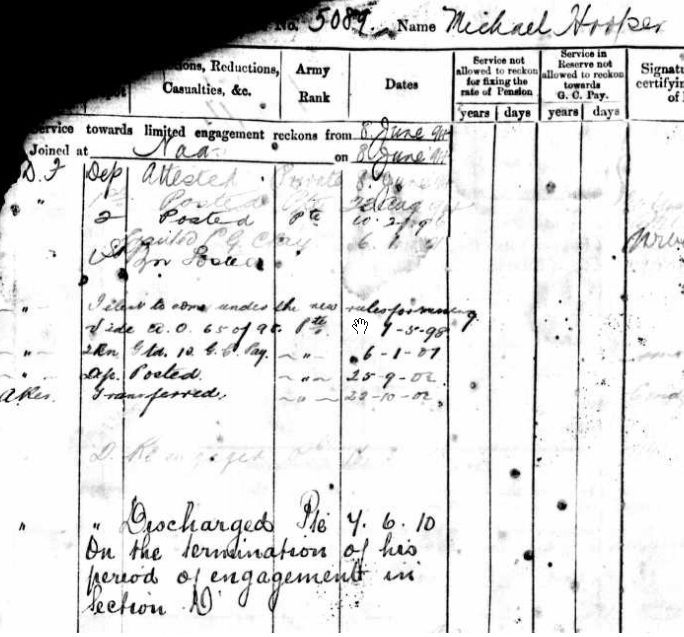
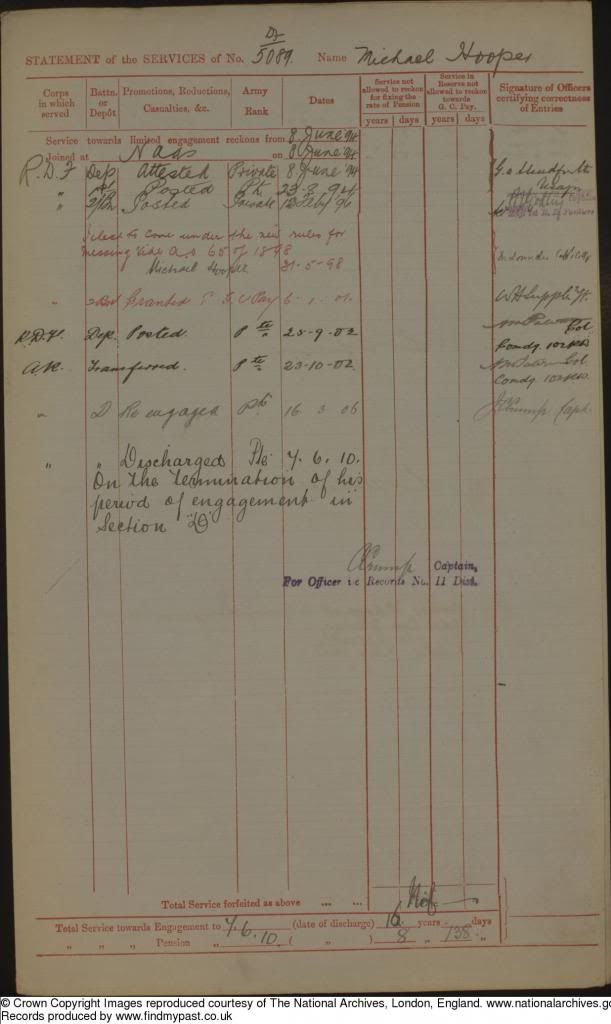
Michael Hooper joined the Royal Dublin Fusiliers on 8th Jun 1894 and was given the regimental number 5089.  He was posted to the Depot and remained there until posted to the Home Battalion (in this case, the 1st Battalion) on the 23rd August 1894. He remained with the 1st Battalion, which was then stationed in Sheffield, until the 10th February 1896 when he was posted to the overseas battalion, the 2nd Battalion.  This battalion would have been stationed in Quetta when Michael Hooper joined it and his service record notes that he remained with the 2nd Battalion until September 1902 when he was posted back to the regimental Depot. In the intervening years, Hooper would have seen service in Bombay, Natal and South Africa, the battalion moving back to Ireland in 1902 (and becoming the Home Battalion) whilst the 1st Battalion, already overseas in South Africa as a result of the Boer War, moved on to Crete and Malta and took up the role of the overseas battalion.
 
Michael Hooper was transferred to the Army Reserve in October 1902 and on completing this period of reserve service elected to join Section D Reserve for a further four years.  He was finally discharged from Section D Reserve  on the 7th June 1910.
 
At no point during his army career, did Michael Hooper's number change.  Why would it?  He joined as a regularsoldier and moved freely between the two battalions during his army career.  Whilst on the reserve, had he been recalled to the Colours, he would have retained his service number.  However, from the moment he was discharged in 1910, his number would also have been discarded.  Even if he walked around the block and decided to re-enlist, that number would not have been re-issued to him. 
 
The image from Michael Hooper's service record in WO 363 (above) is Crown Copyright and reproduced by courtesy of the National Archives.  Interestingly, the same papers (but beautifully preserved) exist in WO 97, so here's another version of the same document:


I also offer a comprehensive, fast and cost-effective military history research service. Follow the link for more information.

Regimental number sequences - county regiments


This may be preaching to the converted, but it's a new year and probably time for a reminder that one number series doesn't fit all.

On this blog I have posted pointers to enlistment dates for many British Army regiments and battalions within those regiments. All of the 69 Infantry of the Line regiments are covered to some degree - mostly number sequences from 1881 to 1914. You'll find the five Foot Guards regiments represented here; also the majority of the Cavalry of the Line; some Special Reserve and Extra Reserve battalions, Territorial Force Battalions and Pals battalions. What is shown on these various posts is simply a snapshot of enlistment dates and numbers, a snapshot which will hopefully assist researchers in narrowing down a likely enlistment date for a soldier based on his number.

Do bear in mind though that a typical county regiment would have employed several different numbering sequences for the men in its battalions. Let's look at the hypothetical Blankshire Regiment and take August 1910 as our starting point.


The regular battalions, that is, the battalions populated by career soldiers, operate a single regimental number sequence. A new recruit is given his number at the Regimental Depot, spends up to three months training at the Depot and is then posted to the 1st Battalion which is stationed in the UK. After 18 months to two years he is then posted to the 2nd Battalion which is serving overseas in India. His posting from the Depot to the 1st Battalion, and then from the 1st Battalion to the 2nd Battalion does not affect his regimental number which remains unchanged.

Also administered from the Regimental Depot are those men who have joined the Special Reserve and Extra Reserve. These battalions are a legacy of the Militia which was disbanded in 1908 and each of these battalions has its own numbering sequence.

So the 3rd (Special Reserve) Battalion , the Blankshire Regiment was, prior to April 1908, the 3rd Militia Battalion whilst the 4th (Extra Reserve) Battalion was, prior to April 1908, the 4th Militia Battalion. This Blankshire Regiment only has a 3rd and 4th Battalion but some County Regiments only have one Special Reserve Battalion whilst across the sea in Ireland, the Irish County regiments typically have one Special Reserve Battalion and two Extra Reserve Battalions. Each battalion has its own numbering sequence.

In addition to the regular battalions and the Special/Extra Reserve Battalions, the Blankshire Regiment has four Territorial Force Battalions. Just as the Special/Extra Reserve Battalions trace their heritage back to the militia, so the Territorial Force, formed in April 1908, traces its origins back to the Volunteer Force. The 5th, 6th, 7th and 8th (Territorial Force) Battalions of the Blankshire Regiment were formerly the 1st, 2nd, 3rd and 4th Volunteer Battalions of the Blankshire Regiment. As Volunteer Force Battalions they operated their own regimental number sequences and now, as Territorial Force Battalions, they continue to operate their own number sequences.

So far then we have the following number sequences for the Blankshire Regiment:

1st and 2nd [Regular] Battalions – Number Sequence 1
3rd (Special Reserve) Battalion – Number Sequence 2
4th (Extra Reserve) Battalion – Number Sequence 3
5th (Territorial Force) Battalion – Number Sequence 4
6th (Territorial Force) Battalion – Number Sequence 5
7th (Territorial Force) Battalion – Number Sequence 6
8th (Territorial Force) Battalion – Number Sequence 7

Britain goes to war in 1914 and soon drafts for the 1st and 2nd Battalions are required. Men from the 3rd (Special Reserve) and 4th (Extra Reserve) Battalions are sent out to France to fill the gaps. They retain their Special Reserve and Extra Reserve Battalion numbers albeit there is often nothing in surviving documentation to distinguish these men’s numbers from the numbers of the regular soldiers. Some medal index cards may prefix these SR and ER men’s numbers with S/ (for Special Reserve) or 3/ or 4/ (to designate their battalion) but this is by no means a uniform practice.

Take a hypothetical example of 3456 John Smith who was KIA with the 1st Blankshire Regiment on 1st December 1914. John Smith was only 20 when he was killed and yet looking at the number sequence posted on this blog for the 1st Blankshires, it suggests that 3456 was issued between January 1894 and January 1895 – when John was 10 years old. How can that be? The answer is almost certainly that John Smith enlisted with the 3rd (Special Reserve) Battalion in 1912. His number fits the sequence being used by the 3rd Battalion and this in turn suggests that he joined the 3rd Battalion but was posted overseas to the 1st Battalion, retaining his 3rd Battalion number.

I will continue to post sequences on this blog – there are many, many more to go – but in the meantime, don’t be puzzled if, on the face of it, a man’s regimental number and the suggested joining date parameters that I have posted, don’t at first appear to make much sense. Don't rule out enlistment in the Special or Extra Reserve battalions.

I also offer a comprehensive, fast and cost-effective military history research service. Follow the link for more information.
30 December 2012

8th (King’s Royal Irish) Hussars


This post will look at numbering in the 8th (King’s Royal Irish) Hussars between 1881 and 1906. The cavalry regiments were unaffected by Cardwell's Army reforms; however, in keeping with the parameters of this blog, my starting point is 1881.

The database and information on this blog have been compiled as a result of studying service records in WO 97 (British Army pensions to 1913), WO 363 (WW1 service records) and WO 364 (WW1 pension records). All of these series are now online. Click on the links for further information.

2214 joined on 17th March 1881
2270 joined on 29th March 1882
2419 joined on 29th May 1883
2606 joined on 29th August 1884
2700 joined on 8th June 1885
2937 joined on 21st January 1886
3117 joined on 3rd January 1887
3224 joined on 13th October 1888
3247 joined on 24th September 1889
3276 joined on 28th February 1890
3329 joined on 12th January 1891
3453 joined on 9th February 1892
3566 joined on 7th February 1893
3685 joined on 16th March 1894
3798 joined on 3rd October 1895
3817 joined on 10th April 1896
3881 joined on 13th April 1897
4117 joined on 10th May 1898
4318 joined on 5th January 1899
4780 joined on 9th January 1900
5282 joined on 5th January 1901
5560 joined on 3rd January 1902
6242 joined on 22nd June 1903
6333 joined on 1st December 1904
6373 joined on 18th January 1905
6833 joined on 4th July 1906

In December 1906, Army Order 289 changed the numbering for cavalry of the line. Prior to this, all cavalry regiments had numbered individually by regiments. Now, line cavalry and household cavalry were separated; each of the three line cavalry corps – dragoons, hussars, and lancers – beginning a new number series which started at 1 and was to extend to 49,999.

What this meant for the 8th Hussars was that from late December 1906 they began a new number sequence which they shared with the all of the Hussars regiments:

3rd (King's Own) Hussars
4th (Queen's Own) Hussars
7th (Queen's Own) Hussars
8th (King's Royal Irish) Hussars
10th (Prince of Wales's Own Royal) Hussars
11th (Prince Albert's Own) Hussars
13th Hussars
14th (King's) Hussars
15th (King's) Hussars
18th (Queen Mary's Own) Hussars
19th (Queen Alexandra's Own Royal) Hussars
20th Hussars

See also, my posts on numbering in the Corps of Hussars 1907-1914, Queen's and King's Regulations: regimental numbering and cavalry numbering in 1906.

7th (Queen's Own) Hussars


This post will look at numbering in the 7th (Queen's Own) Hussars between 1881 and 1906. The cavalry regiments were unaffected by Cardwell's Army reforms; however, in keeping with the parameters of this blog, my starting point is 1881.

The database and information on this blog have been compiled as a result of studying service records in WO 97 (British Army pensions to 1913), WO 363 (WW1 service records) and WO 364 (WW1 pension records). All of these series are now online. Click on the links for further information.

2342 joined on 7th Janruary 1881
2405 joined on 19th December 1882
2406 joined on 2nd March 1883
2546 joined on 13th June 1884
2709 joined on 7th September 1885
2858 joined on 26th January 1886
3153 joined on 22nd January 1887
3320 joined on 17th September 1888
3350 joined on 26th January 1889
3481 joined on 23rd October 1890
3516 joined on 12th January 1891
3675 joined on 13th January 1892
3977 joined on 15th February 1893
4132 joined on 28th March 1894
4215 joined on 23rd October 1895
4231 joined on 30th January 1896
4244 joined on 18th February 1897
4436 joined on 7th November 1898
4590 joined on 31st January 1899
5007 joined on 10th January 1900
5526 joined on 3rd January 1901
5976 joined on 1st January 1902
6679 joined on 21st November 1903
6789 joined on 18th January 1904
6834 joined on 4th October 1905
7045 joined on 2nd April 1906

In December 1906, Army Order 289 changed the numbering for cavalry of the line. Prior to this, all cavalry regiments had numbered individually by regiments. Now, line cavalry and household cavalry were separated; each of the three line cavalry corps – dragoons, hussars, and lancers – beginning a new number series which started at 1 and was to extend to 49,999.

What this meant for the 7th Hussars was that from late December 1906 they began a new number sequence which they shared with the all of the Hussars regiments:

3rd (King's Own) Hussars
4th (Queen's Own) Hussars
7th (Queen's Own) Hussars
8th (King's Royal Irish) Hussars
10th (Prince of Wales's Own Royal) Hussars
11th (Prince Albert's Own) Hussars
13th Hussars
14th (King's) Hussars
15th (King's) Hussars
18th (Queen Mary's Own) Hussars
19th (Queen Alexandra's Own Royal) Hussars
20th Hussars

See my post on numbering in the Corps of Hussars 1907-1914. For further background, also see my posts on Queen's & King's Regulations: regimental numbering and  cavalry numbering in 1906.

29 December 2012

4th (Queen's Own) Hussars 1881-1906


This post will look at numbering in the 4th (Queen's Own) Hussars between 1881 and 1906. The cavalry regiments were unaffected by Cardwell's reforms, the localisation of Infantry of the Line and the pairing of infantry regiments on territorial lines. However, in keeping with the self-imposed parameters of this blog, my starting point is 1881.

The database and information on this blog have been compiled as a result of studying service records in WO 97 (British Army pensions to 1913), WO 363 (WW1 service records) and WO 364 (WW1 pension records). All of these series are now online.

1905 joined on 22nd February 1881
1967 joined on 9th February 1882
2078 joined on 1st January 1883
2153 joined on 5th February 1884
2294 joined on 16th January 1885
2300 joined on 18th March 1886
2570 joined on 17th September 1887
2632 joined on 20th August 1888
2729 joined on 12th September 1889
3006 joined on 22nd November 1890
3056 joined on 10th January 1891
3297 joined on 23rd February 1892
3467 joined on 24th January 1893
3590 joined on 3rd January 1894
3718 joined on 23rd March 1895
3806 joined on 3rd January 1896
4010 joined on 4th February 1897
4081 joined on 7th December 1898
4175 joined on 24th February 1899
4401 joined on 4th January 1900
4444 joined on 6th January 1903
4705 joined on 8th September 1904
4743 joined on 31st August 1905
4768 joined on 3rd May 1906

In December 1906, Army Order 289 changed the numbering for cavalry of the line. Prior to this, all cavalry regiments had numbered individually by regiments. Now, line cavalry and household cavalry were separated; each of the three line cavalry corps – dragoons, hussars, and lancers – beginning a new number series which started at 1 and was to extend to 49,999.

What this meant for the 4th Hussars was that from late December 1906 they began a new number sequence which they shared with the all of the Hussars regiments:

3rd (King's Own) Hussars
4th (Queen's Own) Hussars
7th (Queen's Own) Hussars
8th (King's Royal Irish) Hussars
10th (Prince of Wales's Own Royal) Hussars
11th (Prince Albert's Own) Hussars
13th Hussars
14th (King's) Hussars
15th (King's) Hussars
18th (Queen Mary's Own) Hussars
19th (Queen Alexandra's Own Royal) Hussars
20th Hussars

See my post on numbering in the Corps of Hussars 1907-1914. For further background, also see:

1. Queen's & King's Regulations: regimental numbering
2. Cavalry numbering in 1906

I also offer a comprehensive, fast and cost-effective military history research service. Follow the link for more information.
Corps of Hussars 1907-1914


As I have noted elsewhere, in December 1906, Army Order 289 changed the numbering for cavalry of the line. Prior to this, all cavalry regiments had numbered individually by regiments. Now, line cavalry and household cavalry were separated; each of the three line cavalry corps – dragoons, hussars, and lancers – beginning a new number series which started at 1 and was to extend to 49,999.

The Corps of Hussars consisted of twelve individual regiments, each of these with long and proud histories:

3rd (King's Own) Hussars
4th (Queen's Own) Hussars
7th (Queen's Own) Hussars
8th (King's Royal Irish) Hussars
10th (Prince of Wales's Own Royal) Hussars
11th (Prince Albert's Own) Hussars
13th Hussars
14th (King's) Hussars
15th (King's) Hussars
18th (Queen Mary's Own) Hussars
19th (Queen Alexandra's Own Royal) Hussars
20th Hussars

Now, numbering by regiment was abandoned and the corps of Hussars allocated numbers from a single series.  Here are some numbers from that series which, as they were issued chronologically, should help to provide pointers towards likely enlistment dates for other Hussars recruits.

The H/ (Hussars) prefix appears on some attestation papers but there appears to be no consistency to its usage and my own research shows that more often than not this was not used.

7 joined on 5th January 1907
1096 joined on 13th September 1907
1954 joined on 15th January 1908
2635 joined on 27th June 1908
3901 joined on 28th January 1909
4648 joined on 27th August 1909
5192 joined on 14th January 1910
5869 joined on 28th July 1910
6789 joined on 6th January 1911
7546 joined on 14th October 1911
8146 joined on 8th January 1912
8837 joined on 25th May 1912
9589 joined on 16th January 1913
10287 joined on 25th June 1913
H/10942 joined on 21st January 1914

A future post will look at numbering in the Corps of Hussars from August 1914.

The photo on this post shows my paternal great-grandmother's brother, Bertrand (Bert) Elam, who enlisted with the 20th Hussars in 1894.  He had previously served briefly with the Wiltshire Regiment but had purchased his discharge for £10, as he was entitled to do, having served with the regiment for less than three months.  He served 12 years with the Hussars, re-enlisted with the Rifle Brigade in September 1914, transferred to the Gloucestershire Regiment in 1917 (he wears the Gloucestershire Regiment cap badge in this photo, along with his QSA and 1914 Star ribbons) and finished the war with the Royal Defence Corps. Throughout his army career he served under the alias Herbert Richard Hellam (although to further confuse matters, some papers give hsi surname as Hallam). He has extensive service records which survive in WO 97 (four pages relating to his brief service with the Wiltshire Regiment) and WO 364 (40 pages).

I also offer a comprehensive, fast and cost-effective military history research service. Follow the link for more information.

Grab a book bargain - 1000s of titles